基于物理信息的神经场能够为部分相干定量相位成像进行盲像差校正
物理情報ニューラルフィールドにより、部分的にコヒーレントな定量位相イメージングにおけるブラインド収差補正が可能となる
물리학 정보 신경 필드는 부분적으로 일관된 양적 단계 이미징을 위해 盲 변차 수정을 가능하게 합니다
Los campos neuronales informados por la física permiten la corrección de aberraciones ciegas para imágenes de fase cuantitativas parcialmente coherentes
Les champs neuronaux informés de la physique permettent la correction d'aberration aveugle pour une imagerie de phase quantitative partiellement cohérente
Нейронные поля, информированные физикой, позволяют корректировать слепую аберрацию для частично согласованной количественной фазной визуализации
¹ Smart Computational Imaging Laboratory (SCILab), School of Electronic and Optical Engineering, Nanjing University of Science and Technology, Nanjing 210094, China
中国 南京 南京理工大学电子工程与光电技术学院 智能计算成像实验室
² Smart Computational Imaging Research Institute (SCIRI) of Nanjing University of Science and Technology, Nanjing 210019, China
中国 南京 南京理工大学智能计算成像研究院
³ Jiangsu Key Laboratory of Visual Sensing & Intelligent Perception, Nanjing 210094, China
中国 南京 江苏省视觉传感与智能感知重点实验室
⁴ Institute of Micromechanics and Photonics, Warsaw University of Technology, Warsaw 02-525, Poland
⁵ State Key Laboratory of Extreme Environment Optoelectronic Dynamic Measurement Technology and Instrument, Taiyuan 030051, China
中国 太原 极限环境光电动态测试技术与仪器全国重点实验室
⁶ Department of Biomedical Engineering, City University of Hong Kong, Hong Kong 999077, China
中国 香港 香港城市大学生物医学工程系
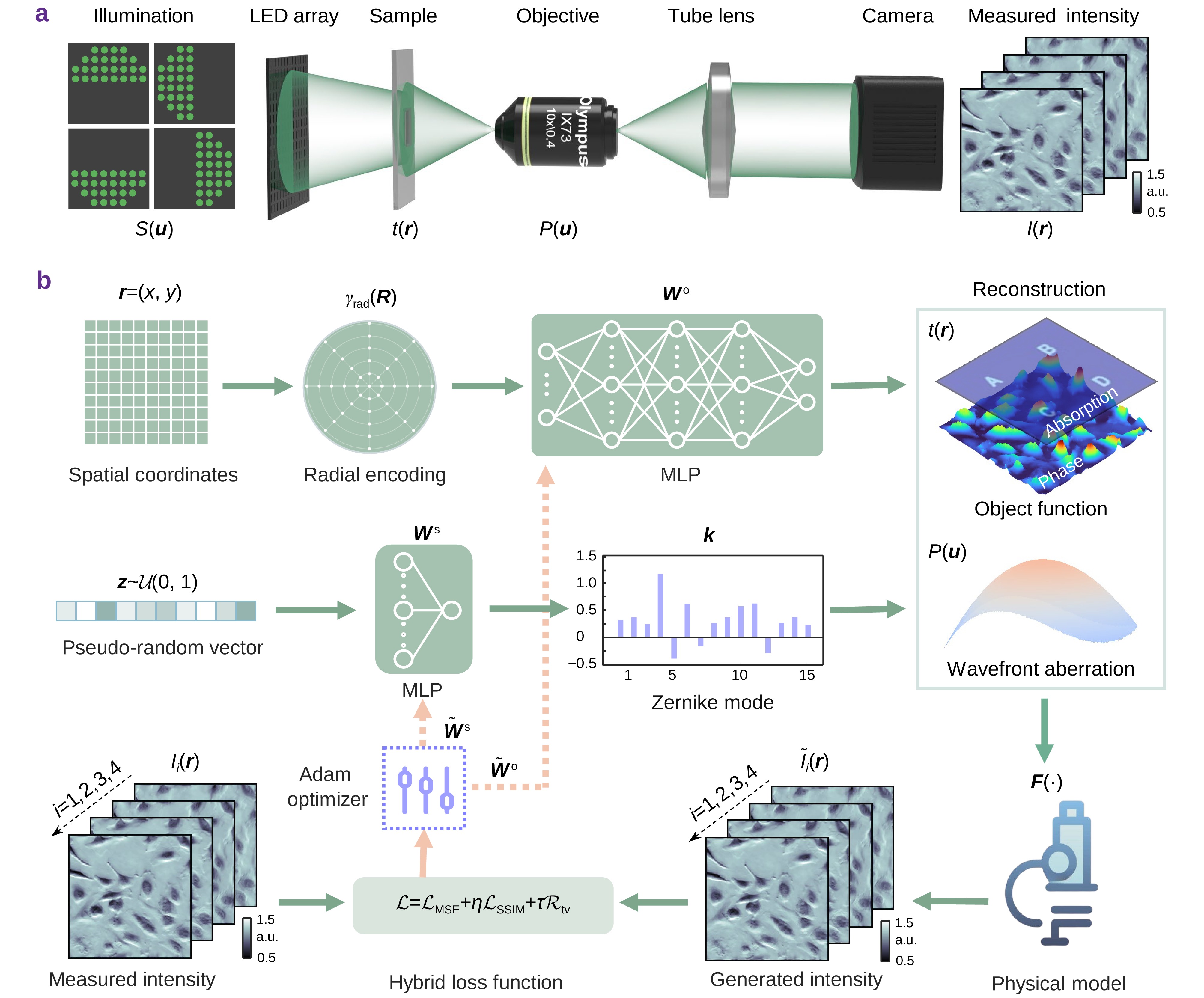
Partially coherent quantitative phase imaging (QPI) underpins label-free microscopy and optical metrology, providing stable, speckle-suppressed phase measurement with a brightfield-compatible platform and resolution beyond the coherent diffraction limit. However, its image formation is governed by a high-dimensional bilinear forward model, making linearized analytic inversions such as differential phase contrast (DPC) prone to model mismatch and biased reconstruction under large phase excursions, strong absorption, and optical aberrations.
Here, we introduce USDPC, a universal neural-field solver for DPC, that performs physics-constrained, unsupervised inversion of the strict nonlinear intensity-to-phase relationship under partially coherent illumination. USDPC represents the specimen's complex transmittance and pupil aberrations as implicit neural fields and jointly optimizes them via a differentiable bilinear forward operator, enabling accurate phase recovery beyond the weak-object regime while self-calibrating unknown aberrations without additional calibration data or acquisition overhead.
Comprehensive simulations and experimental validations on microlens arrays, resolution targets, stained histological sections, and live HeLa cells demonstrate the effectiveness and universality of USDPC, and highlight physics-informed neural fields as a versatile computational framework for solving challenging nonlinear inverse problems in computational imaging and beyond.