Amplitude-Phase Recombination: Rethinking Robustness of Convolutional Neural Networks in Frequency Domain
幅相复合:卷积神经网络频域鲁棒性的再思考
振幅位相再結合:周波数領域における畳込みニューラルネットワークのロバスト性の再考
폭 상 복합:권 적 신경 망 주파수 영역 노 스틱 성의 재고
Composición de amplitud y fase: repensar la robustez del dominio de frecuencia de las redes neuronales de convolución
Composition Amplitude - phase: repenser la robustesse du domaine de fréquence des réseaux neuronaux convolutifs
амплитудно - фазовая рекомбинация: повторное осмысление рутинности в частотном диапазоне свёртывающей нервной сети
Guangyao Chen 陈光耀 ¹, Peixi Peng 彭佩玺 ¹ ³, Li Ma 马力 ¹ ³, Jia Li 李甲 ² ³, Lin Du ⁴, Yonghong Tian 田永鸿 ¹ ³
¹ Department of Computer Science and Technology, Peking University
北京大学计算机科学技术系
² State Key Laboratory of Virtual Reality Technology and Systems, SCSE, Beihang University
北京航空航天大学 虚拟现实技术与系统国家重点实验室
³ Peng Cheng Laborotory
鹏城实验室
⁴ AI Application Research Center, Huawei
华为AI应用研究中心
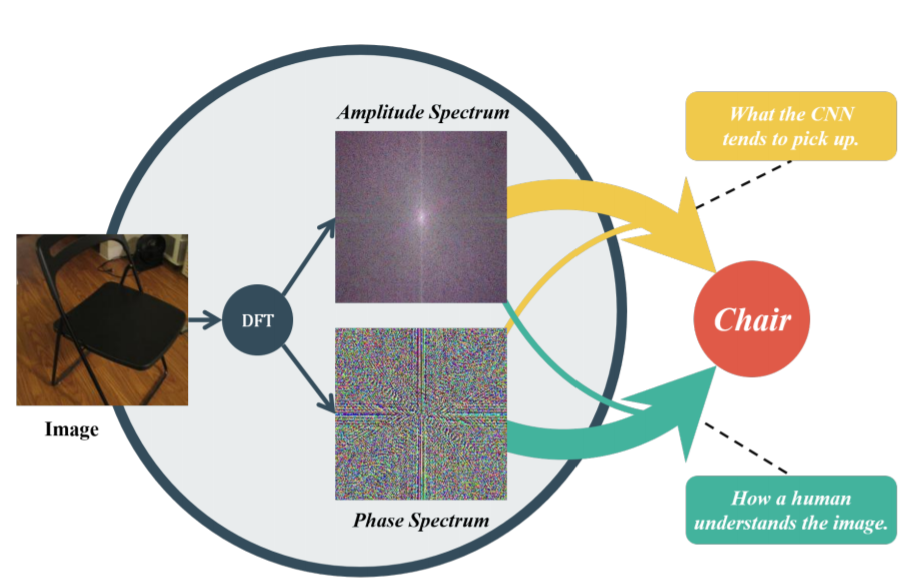
Recently, the generalization behavior of Convolutional Neural Networks (CNN) is gradually transparent through explanation techniques with the frequency components decomposition. However, the importance of the phase spectrum of the image for a robust vision system is still ignored. In this paper, we notice that the CNN tends to converge at the local optimum which is closely related to the high-frequency components of the training images, while the amplitude spectrum is easily disturbed such as noises or common corruptions.
In contrast, more empirical studies found that humans rely on more phase components to achieve robust recognition. This observation leads to more explanations of the CNN's generalization behaviors in both robustness to common perturbations and out-of-distribution detection, and motivates a new perspective on data augmentation designed by re-combing the phase spectrum of the current image and the amplitude spectrum of the distracter image. That is, the generated samples force the CNN to pay more attention to the structured information from phase components and keep robust to the variation of the amplitude.
Experiments on several image datasets indicate that the proposed method achieves state-of-the-art performances on multiple generalizations and calibration tasks, including adaptability for common corruptions and surface variations, out-of-distribution detection, and adversarial attack.