Multiphysics optimization framework for high-power fiber amplifiers
高功率光纤放大器的多物理优化框架
高出力光ファイバ増幅器の多物理最適化フレームワーク
고전력 섬유 증폭기를 위한 다중 물리학 최적화 프레임워크
Multiphysics optimization framework for high-power fiber amplifiers
Cadre d'optimisation multiphysique pour amplificateurs à fibre haute puissance
Система оптимизации мультифизики для высокомощных волоконных усилителей
Wei Liu 刘伟 ¹ ² ³, Zan Cheng 程赞 ¹, Pengfei Ma 马鹏飞 ¹ ² ³, Yisha Chen 陈益沙 ¹ ² ³, Huan Yang 杨欢 ¹ ² ³, Zhiyong Pan 潘志勇 ¹ ² ³, Zefeng Wang 王泽锋 ¹ ² ³, Jinbao Chen 陈金宝 ¹ ² ³
¹ College of Advanced Interdisciplinary Studies, National University of Defense Technology, Changsha 410073, China
中国 长沙 国防科技大学前沿交叉学科学院
² Nanhu Laser Laboratory, National University of Defense Technology, Changsha 410073, China
中国 长沙 国防科技大学南湖之光实验室
³ Hunan Provincial Key Laboratory of High Energy Laser Technology, National University of Defense Technology, Changsha 410073, China
中国 长沙 国防科技大学高能激光技术湖南省重点实验室
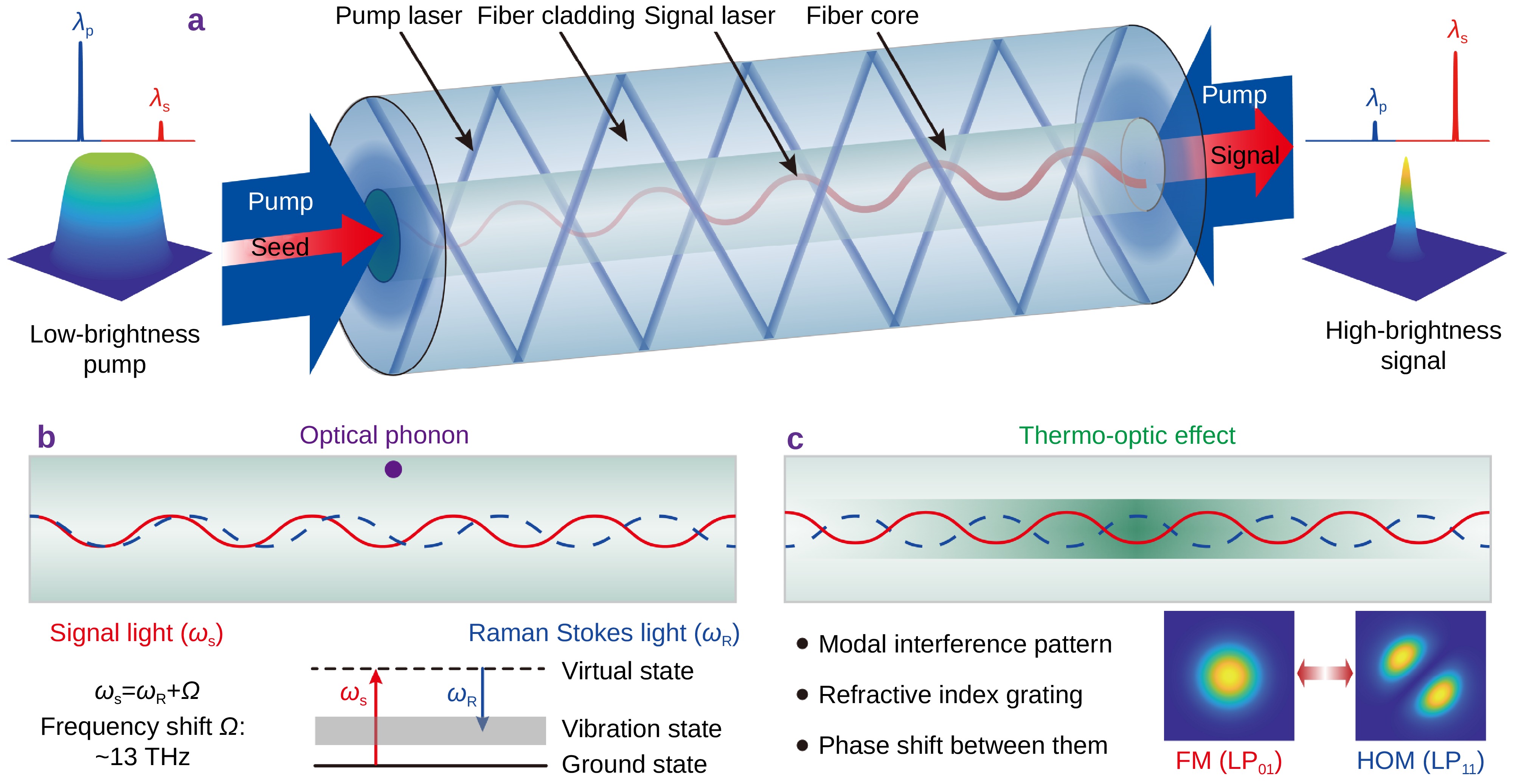
The interplay of nonlinear and thermal dynamics fundamentally constrains the power scalability of fiber lasers. Conventional development cycles rely on heuristic iterations between modeling and experiment, inevitably leading to extensive resource consumption and suboptimal architectures. In this work, we demonstrate a predictive in silico design paradigm for high-power fiber amplifiers by integrating a coupled multiphysics model with a physics-informed, surrogate-assisted optimization algorithm.
This framework enables the efficient co-optimization of macroscopic configurations and internal waveguide parameters, thereby directly identifying the system-level optimum under rigorous physical constraints. Computationally directed by this method, we designed an optimal gain fiber featuring a numerical aperture of 0.0585 and a centrally depressed refractive index profile. Upon physical fabrication and integration into a 0.5-nm-linewidth setup, the amplifier delivered an output power of 7.68 kW with high optical-to-optical efficiency (84%) and excellent beam quality (M2<1.5), setting a new power record for sub-nanometer-linewidth fiber lasers.
This generalizable framework paves the way to unlock previously inaccessible performance regimes in high-power lasers and accelerate the realization of fully functional digital twins for next-generation photonic systems.