Predicting the CME arrival time based on the recommendation algorithm
基于推荐算法的CME到达时间预测
推奨アルゴリズムに基づいてCME到着時間を予測する
추천 알고리즘을 기반으로 CME 도착 시간 예측
Predecir la hora de llegada de CME según el algoritmo de recomendación
Prédire l'heure d'arrivée du CME en fonction de l'algorithme de recommandation
Прогнозирование времени прибытия CME на основе алгоритма рекомендаций
Yu-Rong Shi 石育榕 ¹ ² ³, Yan-Hong Chen 陈艳红 ¹ ³, Si-Qing Liu 刘四清 ¹ ² ³, Zhu Liu 刘柱 ⁴, Jing-Jing Wang 王晶晶 ¹ ³, Yan-Mei Cui 崔延美 ¹ ³, Bingxian Luo 罗冰显 ¹ ² ³, Tian-Jiao Yuan 袁天娇 ¹ ³, Feng Zheng 郑锋 ⁴, Zisiyu Wang 王子思禹 ¹ ² ³, Xin-Ran He 何欣燃 ¹ ² ³, Ming Li 李铭 ¹ ² ³
¹ National Space Science Center, Chinese Academy of Sciences, Beijing 100190, China
中国 北京 中国科学院国家空间科学中心
² University of Chinese Academy of Sciences, Beijing 100049, China
中国 北京 中国科学院大学
³ Key Laboratory of Science and Technology on Environmental Space Situation Awareness, Chinese Academy of Sciences, Beijing 100190, China
中国 北京 中国科学院空间环境态势感知技术重点实验室
⁴ Department of Computer Science and Engineering, Southern University of Science and Technology, Shenzhen 518055, China
中国 深圳 南方科技大学计算机科学与工程系
Research in Astronomy and Astrophysics (RAA), 17 March 2021 (accepted)
Abstract
CME is one of the important events in the sun-earth system as it can induce geomagnetic disturbance and an associated space environment effect. It is of special significance to predict whether CME will reach the Earth and when it will arrive. In this paper, we firstly built a new multiple association list for 215 different events with 18 characteristics including CME features, eruption region coordinates
and solar wind parameters.
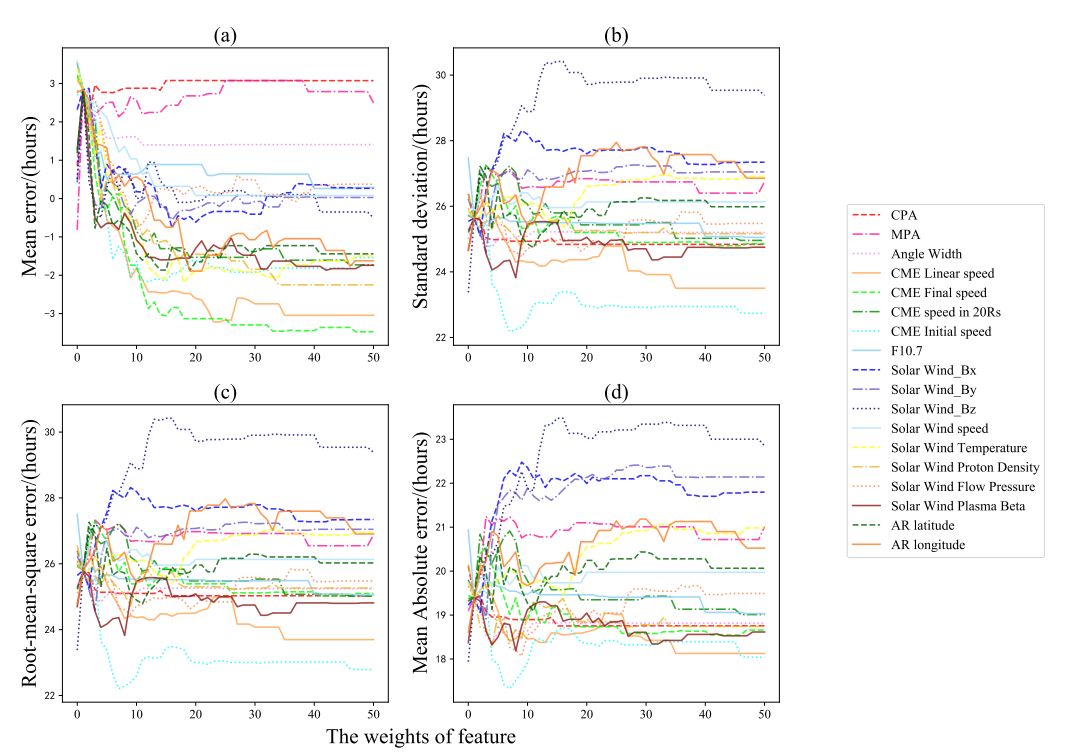
Based on the CME list, we designed a novel model based on the principle of the recommendation algorithm to predict the arrival time of CMEs. According to the two commonly used calculation methods in the recommendation system, cosine distance and Euclidean distance, a controlled trial was carried out respectively. Every feature has been found to have its own appropriate weight. The error analysis indicates the result using the Euclidean distance similarity is much better than that using cosine distance similarity.
The mean absolute error and root mean square error of test data in the Euclidean distance are 11.78 and 13.77 h, close to the average level of other CME models issued in the CME scoreboard, which verifies the effectiveness of the recommendation algorithm. This work gives a new endeavor using the recommendation algorithm, and is expected to induce other applications in space weather prediction.