A stepless-power-reconfigurable converter for a constant current underwater observatory
一种用于恒流水下天文台的无级功率可重构转换器
定電流水中観測所用の無段階電力再構成可能コンバータ
정전류 수중전망대용 무단 전력 재구성 컨버터
Un convertidor reconfigurable de potencia continua para un observatorio submarino de corriente constante
Un convertisseur reconfigurable à puissance continue pour un observatoire sous-marin à courant constant
Преобразователь с бесступенчатой реконфигурацией мощности для подводной обсерватории постоянного тока
Yujia Zang 臧玉嘉 ¹ ², Yanhu Chen 陈燕虎 ¹, Canjun Yang 杨灿军 ¹, Haoyu Zhang 张浩宇 ¹, Zhiyong Duan 段志勇 ¹, Gul Muhammad ¹
State Key Laboratory of Fluid Power and Mechatronic Systems, Zhejiang University, Hangzhou 310027, China
中国 杭州 浙江大学流体动力与机电系统国家重点实验室
² Ji Hua Laboratory, Foshan 528200, China
中国 佛山 季华实验室
Frontiers of Information Technology & Electronic Engineering, 23 December 2021
Abstract
The conversion from constant current (CC) to constant voltage (CV) is one of the key technologies of CC underwater observatory systems. A shunt regulator with high stability and high reliability is usually used. Applications, however, are limited by high heat dissipation and low efficiency. In this paper, with an improved shunt regulation method, a novel concept of stepless power reconfiguration (SPR) for the CC/CV module is proposed.
In cases with stable or slowly changing load, two modes of CC/CV conversion are proposed to reduce unnecessary power loss of the shunt regulator while being able to retain any operator-preset power margin in the system: (1) the manual SPR (MSPR) method based on single-loop control method; (2) the automatic SPR (ASPR) method based on inner-outer loop control method. The efficiency of the system is analyzed. How to select some key parameters of the system is discussed.
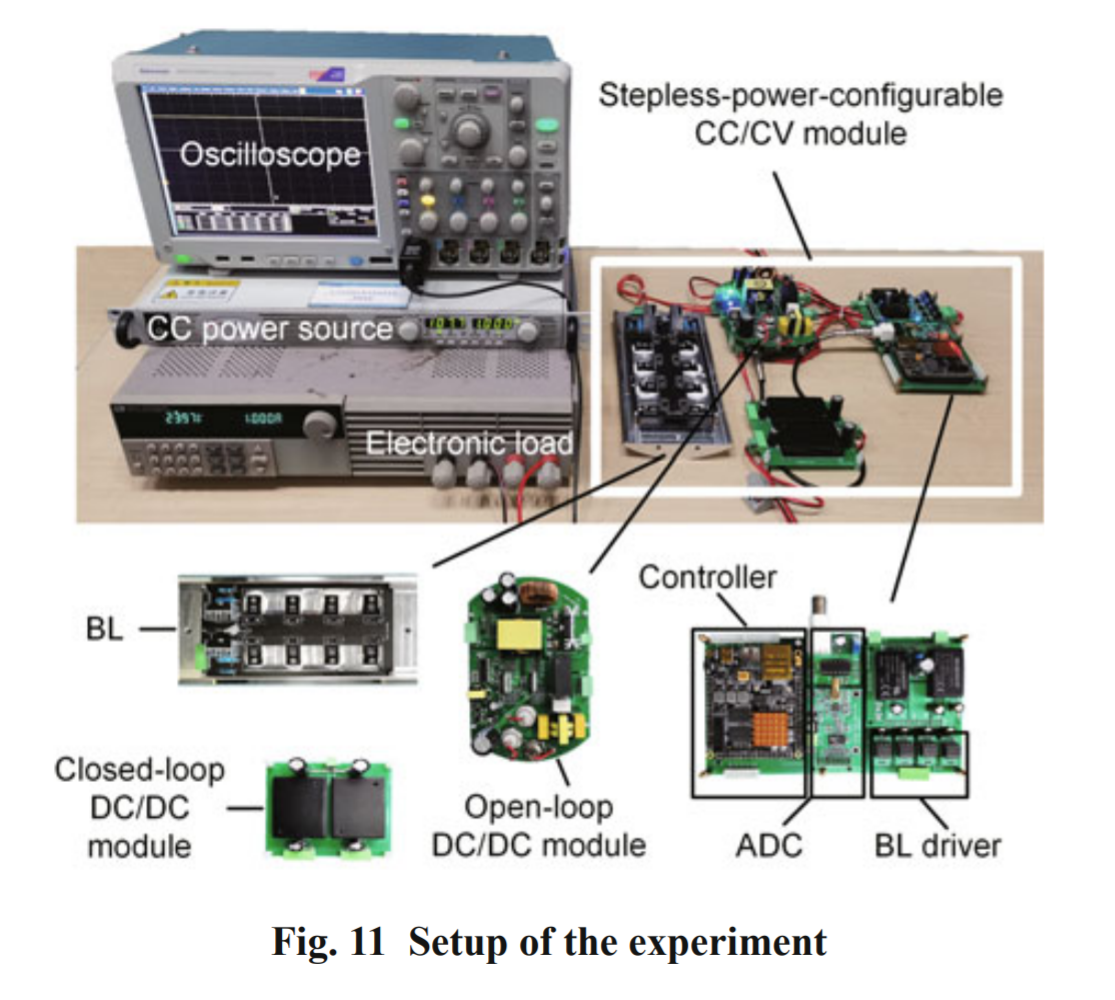
Experimental results show that MSPR and ASPR are both effective and practical methods to reduce heat dissipation and improve the efficiency of the CC/CV module, while the high stability of the shunt regulator remains.