Beyond Lambertian light trapping for large-area silicon solar cells: fabrication methods
超越朗伯光捕获的大面积硅太阳能电池:制造方法
大面積シリコン太陽電池のランバート光トラッピングを超えて:製造方法
대면적 실리콘 태양전지를 위한 Lambertian 광 포획을 넘어서: 제조 방법
Más allá de la captura de luz lambertiana para células solares de silicio de gran superficie: métodos de fabricación
Au-delà du piégeage de la lumière lambertienne pour les cellules solaires au silicium de grande surface : méthodes de fabrication
Помимо ламбертовского улавливания света для кремниевых солнечных элементов большой площади: методы изготовления
Jovan Maksimovic ¹, Jingwen Hu ¹, Soon Hock Ng ¹, Tomas Katkus ¹, Gediminas Seniutinas ¹, Tatiana Pinedo Rivera ², Michael Stuiber ², Yoshiaki Nishijima ³ ⁴, Sajeev John ⁵, Saulius Juodkazis ¹ ⁶
¹ Optical Sciences Centre and ARC Training Centre in Surface Engineering for Advanced Materials (SEAM), School of Science, Swinburne University of Technology, Hawthorn Vic 3122, Australia
² Melbourne Centre for Nanofabrication, ANFF Victoria, 151 Wellington Rd., Clayton Vic 3168 Australia
³ Department of Electrical and Computer Engineering, Graduate School of Engineering, Yokohama National University, 79-5 Tokiwadai, Hodogaya-ku, Yokohama 240-8501, Japan
⁴ Institute of Advanced Sciences, Yokohama National University, 79-5 Tokiwadai, Hodogaya-ku, Yokohama 240-8501, Japan
⁵ Department of Physics, University of Toronto, 60 St. George Street, Toronto, ON, M5S 1A7, Canada
⁶ World Research Hub Initiative (WRHI), School of Materials and Chemical Technology, Tokyo Institute of Technology, 2-12-1, Ookayama, Meguro-ku, Tokyo 152-8550, Japan
Light trapping photonic crystal (PhC) patterns on the surface of Si solar cells provides a novel opportunity to approach the theoretical efficiency limit of 32.3%, for light-to-electrical power conversion with a single junction cell. This is beyond the efficiency limit implied by the Lambertian limit of ray trapping ~ 29%. The interference and slow light effects are harnessed for collecting light even at the long wavelengths near the Si band-gap.
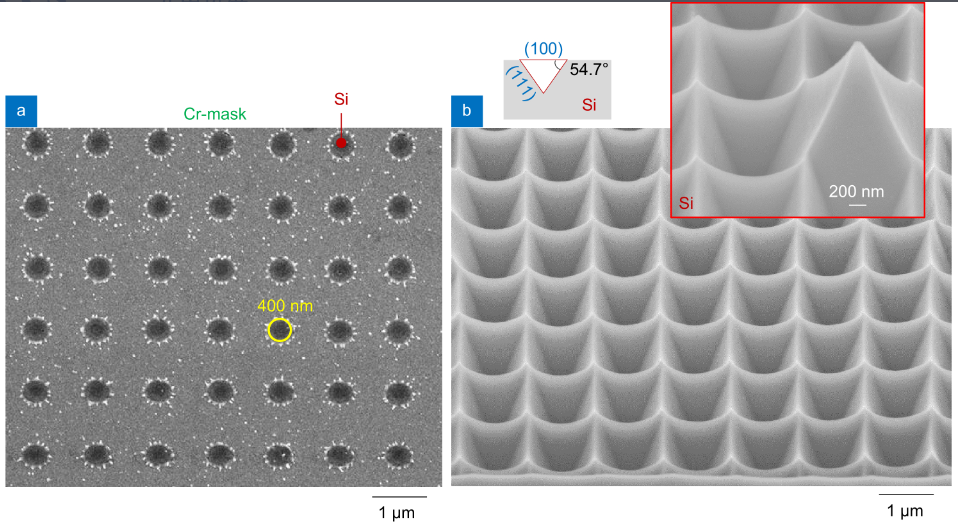
We compare two different methods for surface patterning, that can be extended to large area surface patterning: 1) laser direct write and 2) step-&-repeat 5× reduction projection lithography. Large area throughput limitations of these methods are compared with the established electron beam lithography (EBL) route, which is conventionally utilised but much slower than the presented methods.
Spectral characterisation of the PhC light trapping is compared for samples fabricated by different methods. Reflectance of Si etched via laser patterned mask was ~ 7% at visible wavelengths and was comparable with Si patterned via EBL made mask. The later pattern showed a stronger absorbance than the Lambertian limit. (M.-L. Hsieh et al., Sci. Rep. 10, 11857 (2020)).