Enhanced photoacoustic microscopy with physics-embedded degeneration learning
具有物理嵌入退化学习的增强光声显微镜
物理埋め込み劣化学習を有する強化光音響顕微鏡
물리 내장 퇴화 학습을 갖춘 향상된 광음 현미경
Microscopía fotoacústica mejorada con aprendizaje de degradación de incrustación física
Microscope photoacoustique amélioré avec apprentissage dégénératif intégré physiquement
Улучшенный фотоакустический микроскоп с физическим встроенным дегенеративным обучением
¹ Smart Computational Imaging Laboratory (SCILab), School of Electronic and Optical Engineering, Nanjing University of Science and Technology, Nanjing 210094, China
中国 南京 南京理工大学 电子工程与光电技术学院 智能计算成像实验室
² Smart Computational Imaging Research Institute (SCIRI) of Nanjing University of Science and Technology, Nanjing 210019, China
中国 南京 南京理工大学 智能计算成像实验室
³ Jiangsu Key Laboratory of Spectral Imaging & Intelligent Sense, Nanjing 210094, China
中国 南京 江苏省光谱成像与智能感知重点实验室
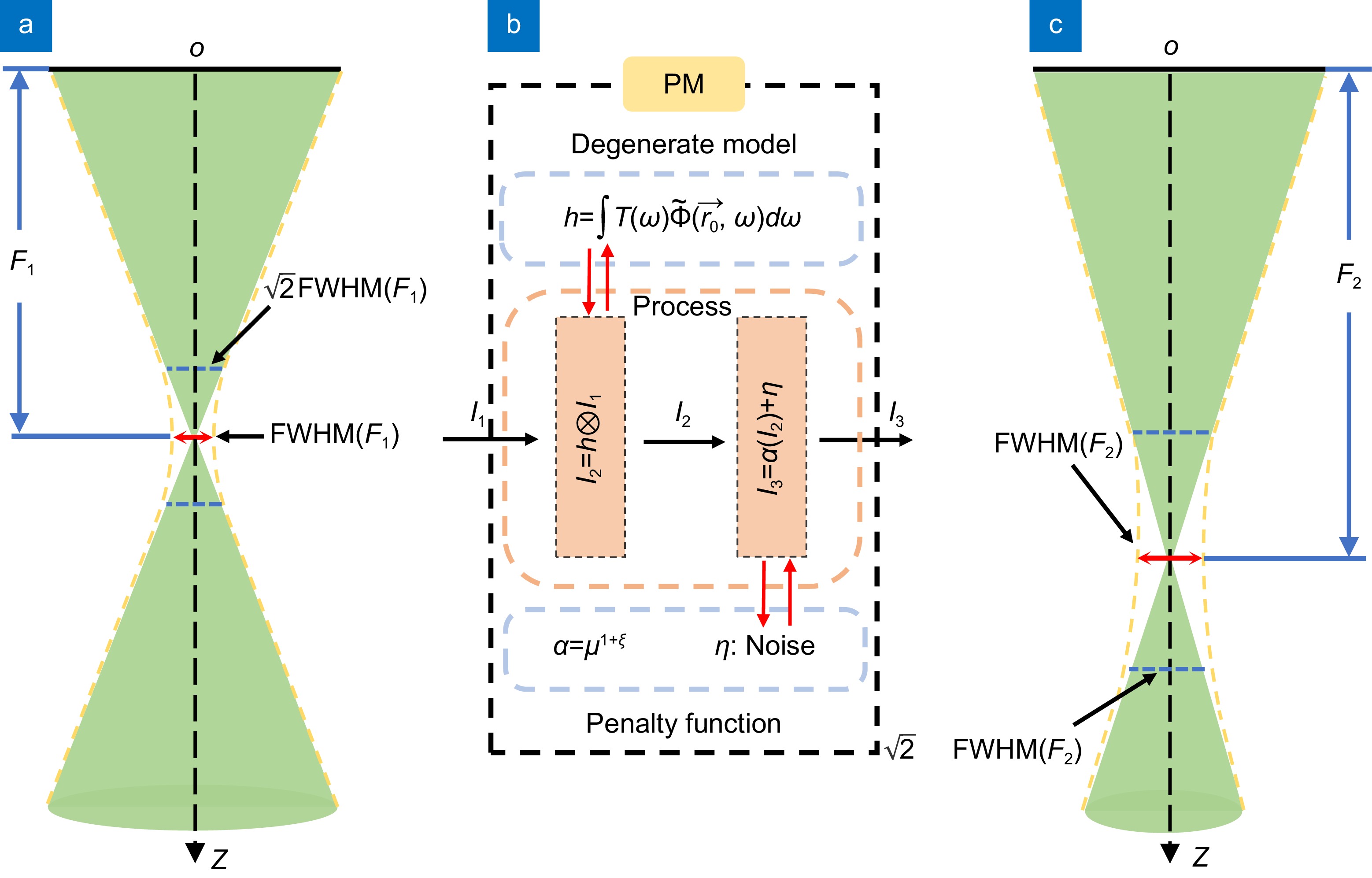
Deep learning (DL) is making significant inroads into biomedical imaging as it provides novel and powerful ways of accurately and efficiently improving the image quality of photoacoustic microscopy (PAM). Off-the-shelf DL models, however, do not necessarily obey the fundamental governing laws of PAM physical systems, nor do they generalize well to scenarios on which they have not been trained.
In this work, a physics-embedded degeneration learning (PEDL) approach is proposed to enhance the image quality of PAM with a self-attention enhanced U-Net network, which obtains greater physical consistency, improves data efficiency, and higher adaptability. The proposed method is demonstrated on both synthetic and real datasets, including animal experiments in vivo (blood vessels of mouse's ear and brain). And the results show that compared with previous DL methods, the PEDL algorithm exhibits good performance in recovering PAM images qualitatively and quantitatively.
It overcomes the challenges related to training data, accuracy, and robustness which a typical data-driven approach encounters, whose exemplary application envisions to provide a new perspective for existing DL tools of enhanced PAM.