YYYY
MMM
Ultrahigh performance passive radiative cooling by hybrid polar dielectric metasurface thermal emitters
混合极性电介质超表面热发射器的超高性能被动辐射冷却
混合極性誘電体超表面熱放射器の超高性能受動放射冷却
혼합극성 전매체 초표면 열발사기의 초고성능 피동 복사 냉각
Enfriamiento por radiación pasiva de alto rendimiento del emisor de calor supersuperficial dieléctrico polar híbrido
Refroidissement radiatif passif ultra haute performance pour émetteurs de chaleur ultra - surface à diélectrique polaire mixte
сверхвысокопроизводительное пассивное радиационное охлаждение сверхповерхностных теплопередатчиков со смешанным диэлектриком
Yinan Zhang 张轶楠 ¹, Yinggang Chen 陈迎港 ¹ ², Tong Wang 王彤 ¹, Qian Zhu 朱倩 ¹, Min Gu 顾敏 ¹
¹ Institute of Photonic Chips, University of Shanghai for Science and Technology, Shanghai 200093, China
中国 上海 上海理工大学 光子芯片研究院
² Centre for Artificial-Intelligence Nanophotonics, School of Optical-Electrical and Computer Engineering, University of Shanghai for Science and Technology, Shanghai 200093, China
中国 上海 上海理工大学 光电信息与计算机工程学院 人工智能纳米光子学中心
Opto-Electronic Advances, 12 March 2024
Abstract

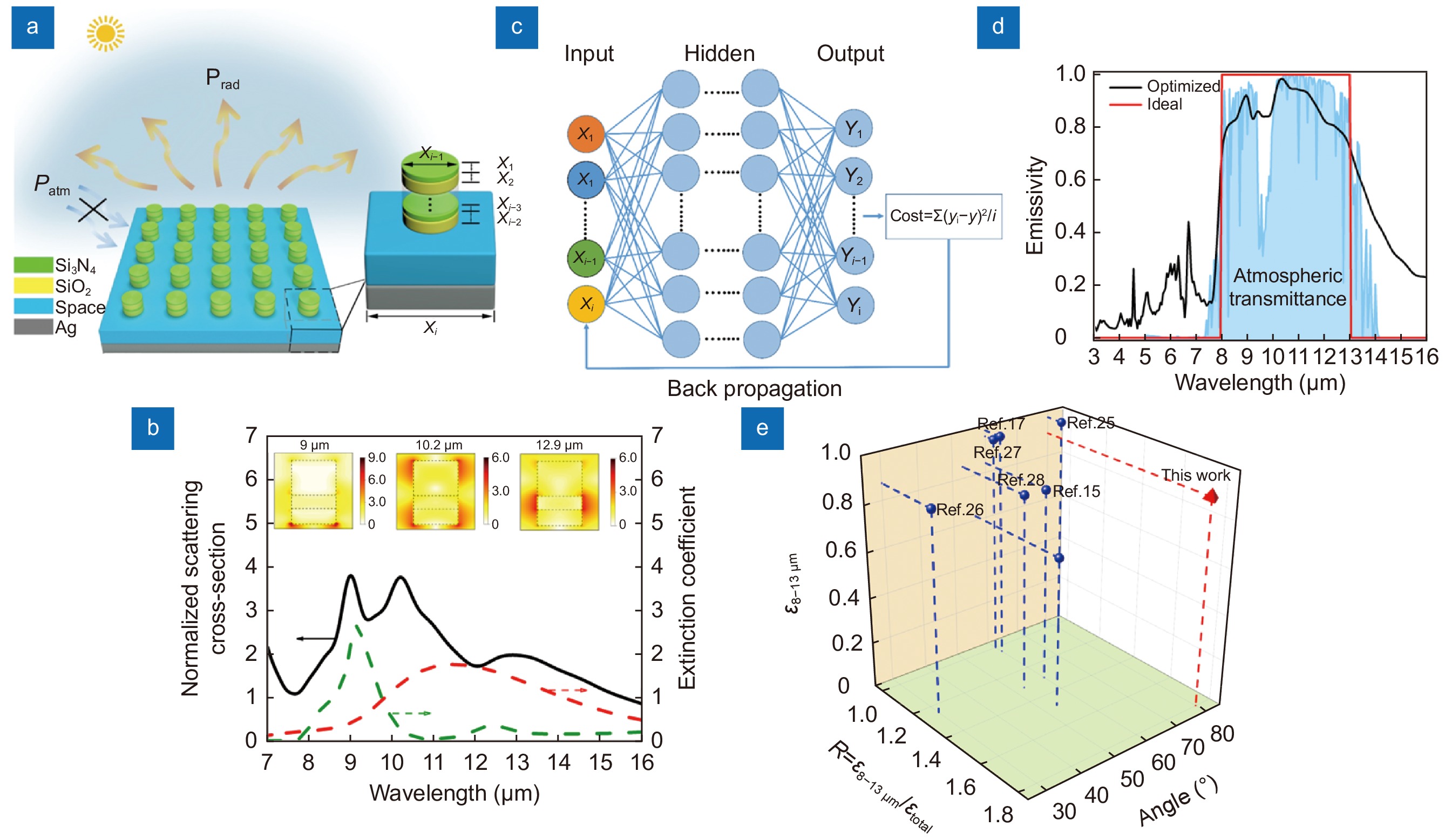
Real-world passive radiative cooling requires highly emissive, selective, and omnidirectional thermal emitters to maintain the radiative cooler at a certain temperature below the ambient temperature while maximizing the net cooling power. Despite various selective thermal emitters have been demonstrated, it is still challenging to achieve these conditions simultaneously because of the extreme difficulty in controlling thermal emission of photonic structures in multidimension.

Here we demonstrated hybrid polar dielectric metasurface thermal emitters with machine learning inverse design, enabling a high emissivity of ~0.92 within the atmospheric transparency window 8–13 μm, a large spectral selectivity of ~1.8 and a wide emission angle up to 80 degrees, simultaneously. This selective and omnidirectional thermal emitter has led to a new record of temperature reduction as large as ~15.4 °C under strong solar irradiation of ~800 W/m2, significantly surpassing the state-of-the-art results.

The designed structures also show great potential in tackling the urban heat island effect, with modelling results suggesting a large energy saving and deployment area reduction. This research will make significant impact on passive radiative cooling, thermal energy photonics and tackling global climate change.

Opto-Electronic Advances_1
Opto-Electronic Advances_2
Opto-Electronic Advances_3
Opto-Electronic Advances_4
Reviews and Discussions
https://www.hotpaper.io/index.html
Ultrafast laser direct writing of highly conductive copper micropatterns
Recent advances in fiber-tip integration based on femtosecond laser 3D printing
Neural holography enabled multi-beam steering for multi-task classifier
Nearly vertically emitted nonlinear light sources with high efficiencies enabled by high-Q nearly-degenerate polygon modes
Multiple degrees-of-freedom optical encryption via pixel-resolved vectorial holography
Recent progress on mid-infrared and terahertz dual-comb spectroscopy
Optical packaging of photonic integrated circuits: bottlenecks and potential solutions
Laser-induced phase transitions in 2D materials: from microscopic mechanisms to device applications
Halide perovskite-based metasurfaces: structure design, performance regulation, and optoelectronic applications
Femtosecond laser based “Janus-material/function” processing paradigm for photothermal and radiative cooling modulation
Electrically switchable bright-field and interference-synthesized edge-enhanced imaging with a polarization-multiplexed metalens
Multiphysics optimization framework for high-power fiber amplifiers


Previous Article                                Next Article
About
|
Contact
|
Copyright © Hot Paper