CMML: Contextual Modulation Meta Learning for Cold-Start Recommendation
CMML:冷启动推荐的上下文调制元学习
CMML:コールドスタート勧告のための文脈変調メタ学習
CMML:콜 드 시작 추천 컨 텍스트 변조 원 학습
CMML: metaaprendizaje de modulación de contexto recomendado para arranque en frío
CMML: méta - apprentissage de la modulation contextuelle recommandée pour le démarrage à froid
CMML: холодный запуск рекомендуемый элемент модуляции контекста
Xidong Feng ¹, Chen Chen ², Dong Li ², Mengchen Zhao ², Jianye Hao 郝建业 ², Jun Wang 汪军 ¹
¹ University College London
² Noah’s Ark Lab, Huawei
华为诺亚方舟实验室
Practical recommender systems experience a cold-start problem when observed user-item interactions in the history are insufficient. Meta learning, especially gradient based one, can be adopted to tackle this problem by learning initial parameters of the model and thus allowing fast adaptation to a specific task from limited data examples.
Though with significant performance improvement, it commonly suffers from two critical issues: the non-compatibility with mainstream industrial deployment and the heavy computational burdens, both due to the inner-loop gradient operation. These two issues make them hard to be applied in practical recommender systems. To enjoy the benefits of meta learning framework and mitigate these problems, we propose a recommendation framework called Contextual Modulation Meta Learning (CMML).
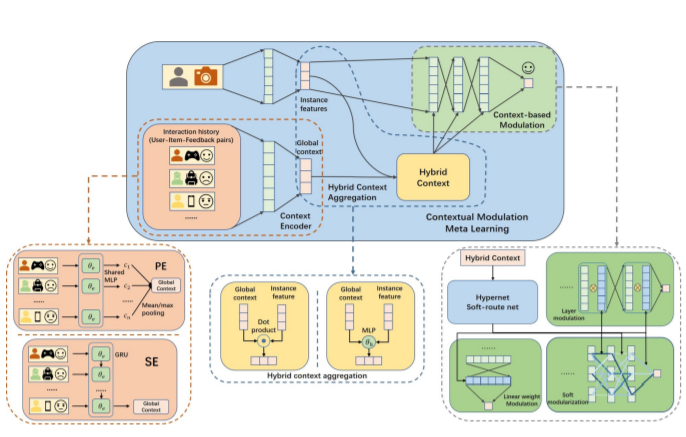
CMML is composed of fully feed-forward operations so it is computationally efficient and completely compatible with the mainstream industrial deployment. CMML consists of three components, including a context encoder that can generate context embedding to represent a specific task, a hybrid context generator that aggregates specific user-item features with task-level context, and a contextual modulation network, which can modulate the recommendation model to adapt effectively.
We validate our approach on both scenario-specific and user-specific cold-start setting on various real-world datasets, showing CMML can achieve comparable or even better performance with gradient based methods yet with much higher computational efficiency and better interpretability.