Dating the First Case of COVID-19 Epidemic from a Probabilistic Perspective
从概率角度确定首例 COVID-19 流行病的日期
確率論的観点からのCOVID-19エピデミックの最初の症例の年代測定
확률적 관점에서 COVID-19 전염병의 첫 번째 사례 데이트
Datación del primer caso de epidemia de COVID-19 desde una perspectiva probabilística
Datation du premier cas d'épidémie de COVID-19 d'un point de vue probabiliste
Вероятностная оценка первого случая эпидемии COVID-19
Zhouwang Yang 杨周旺 ¹, Yunhe Hu 胡云鹤 ¹, Zhiwei Ding 丁志伟 ¹, Tiande Guo 郭田德 ²
¹ University of Science and Technology of China
中国科学技术大学
² University of Chinese Academy of Sciences
中国科学院大学
In the early days of the epidemic of coronavirus disease 2019 (COVID-19), due to insufficient
knowledge of the pandemic, inadequate nucleic acid tests, lack of timely data reporting, etc., the origin time of the onset of COVID-19 is difficult to determine. Therefore, source tracing is crucial for infectious disease prevention and control. The purpose of this paper is to infer the origin time of pandemic of COVID-19 based on a data and model hybrid driven method.
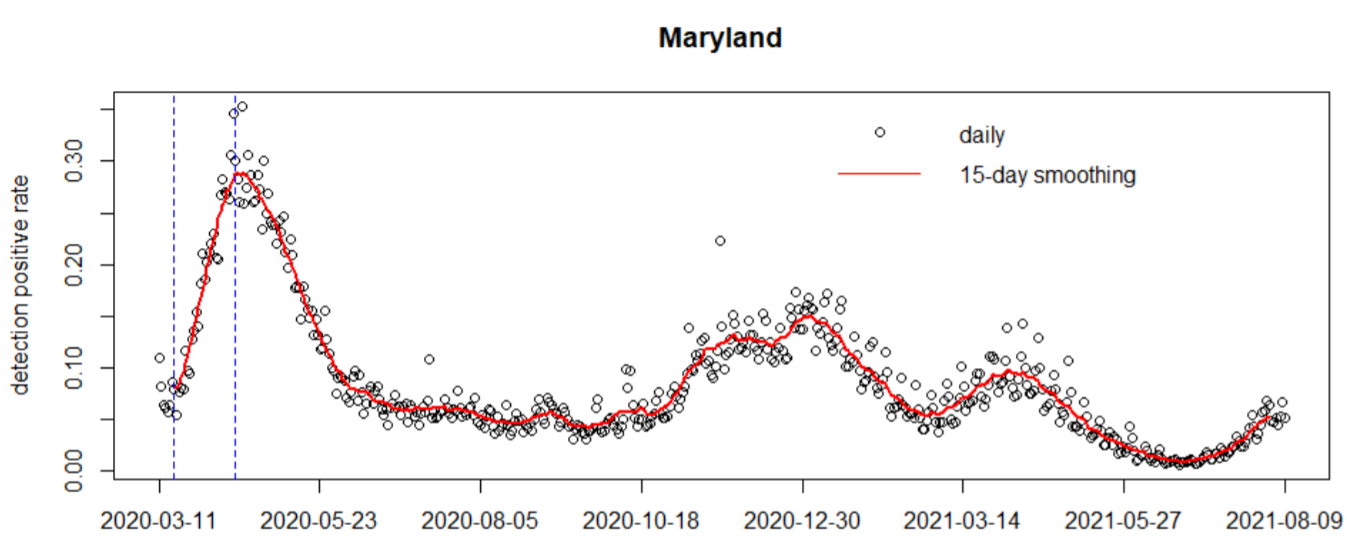
We model the testing positive rate to fit its actual trend, and use the least squares estimation toobtain the optimal model parameters. Further, the kernel density estimation is applied to infer the origin time of pandemic given the specific confidence probability.
By selecting 12 representative regions in the United States for analysis, the dates of the first
infected case with 50% confidence probability are mostly between August and October 2019, which are earlier than the officially announced date of the first confirmed case in the United States on January 20, 2020. The experimental results indicate that the COVID-19 pandemic in the United States starts to spread around September 2019 with a high confidence probability.
In addition, the existing confirmed cases are also used in Wuhan City and Zhejiang Province in China to infer the origin time of COVID-19 and provide the confidence probability. The results show that the spread of COVID-19 pandemic in China is likely to begin in late December 2019.