MMM
YYYY
Highly sensitive and real-simultaneous CH4/C2H2 dual-gas LITES sensor based on Lissajous pattern multi-pass cell
基于Lissajous模式多通道单元的高灵敏度、实时同步CH₄/C₂H₂双气体LITES传感器
Lissajousモードマルチチャネルユニットに基づく高感度、リアルタイム同期CH₄/C₂H₂二ガスLITESセンサ
Lissajous 모드 다중 채널 유닛을 기반으로 한 고감도, 실시간 동기화 CH₄/C₂H₂중 가스 LITES 센서
Highly sensive and Real - simulanoeus CH₄/C₂H₂ Dual - gas lites sensor Base on lisajous Pattern multi - pass Cell
Haute sensibilité et réel - Simultaneous ch₄ / c₂h₂ Dual - Gas lites sensor base sur Lissajous Pattern Multi - pass Cell
Высокий уровень чувствительности и реалистичности CH₄/C₂H₂ dual - gas LITES sensor based on Lissajous pattern multi - pass cell

Haiyue Sun 孙海岳, Ying He 何应, Shunda Qiao 乔顺达, Yahui Liu 刘亚辉, Yufei Ma 马欲飞
National Key Laboratory of Laser Spatial Information, Harbin Institute of Technology, Harbin 150000, China
中国 哈尔滨 哈尔滨工业大学 激光空间信息全国重点实验室
Opto-Electronic Science, 28 June 2024
Abstract

In this paper, a novel highly sensitive methane (CH₄) and acetylene (C₂H₂) dual-gas light-induced thermoelectric spectroscopy (LITES) sensor based on Lissajous space-division multiplexed (LSDM) technology and trapezoidal-head quartz tuning fork (QTF) detector was reported for the first time.

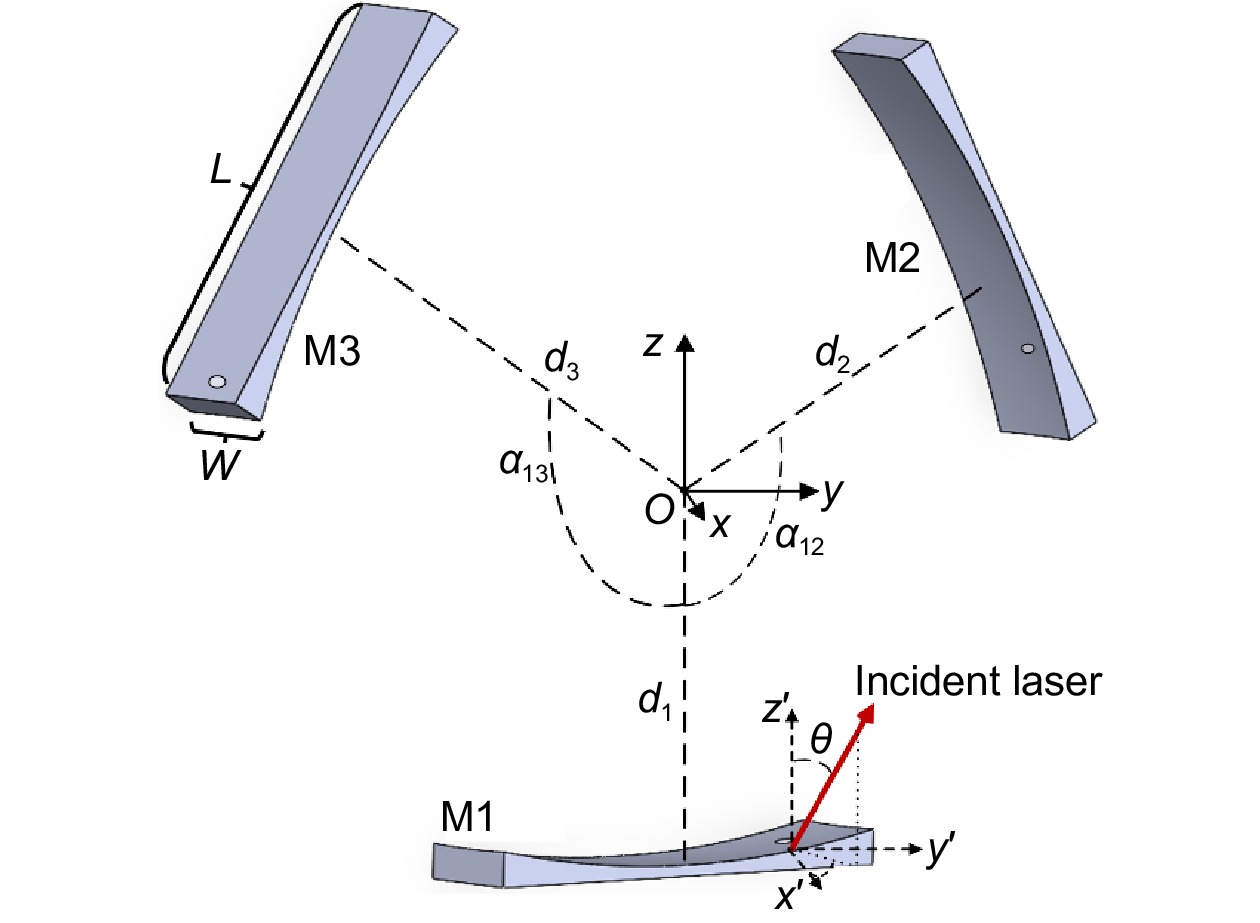
A theoretical LSDM model was established on the basis of three-mirror astigmatic multi-pass cell (MPC) and it was used to design a pair of Lissajous spot patterns with optical path length to volume ratios (OPL/Vs) of 13.5 cm⁻² and 13.3 cm⁻², respectively. Two self-designed trapezoidal-head QTFs with low resonant frequencies of less than 10 kHz and quality factor of ~12000 were adopted to enhance the detection ability. Two kinds of fiber amplifier, erbium doped fiber amplifier (EDFA) and Raman fiber amplifier (RFA), were combined to amplify the output power of two diode lasers to improve the excitation strength.

After optimization, minimum detection limit (MDL) of 268.8 ppb and 91.4 ppb for real-simultaneous CH₄ and C₂H₂ sensing were obtained, respectively. When the integration time of the system were 150 s and 100 s, the MDLs could be improved to 54.8 ppb and 26.1 ppb, accordingly. Further improvement methods for such sensor were discussed.
Opto-Electronic Science_1
Opto-Electronic Science_2
Opto-Electronic Science_3
Opto-Electronic Science_4
Reviews and Discussions
https://www.hotpaper.io/index.html
Triplet exciton harvesting via TADF in hafnium chlorides array scintillator screen enables ultrahigh-resolution X-ray imaging
Vacancy oscillating mode in amorphous binary oxide film by terahertz time domain spectroscopy
Rayleigh-driven ethanol cluster tracking based on non-contact deep optical molecular diagnosis
Imprinted high-Q polymer micro-ring resonator array for high-resolution photoacoustic tomography
Emerging optical techniques for sorting and detection of chiral particles
Multistable soliton dynamics in an optical microresonator
AI-powered nonlinear optical imaging reveals protein spatial homogenization as an indicator of impaired bone quality in type 2 diabetes
Highly sensitive SWCNT-based pyroelectric phototransistors for broadband room temperature infrared detection
Active retinal projection augmented reality display via pixel-to-pixel collimation
Massively parallel and programmable photonic differential equation solver
Femtosecond laser maskless direct writing of dual-band crosstalk-free information for all-in-one high-security encryption metasurface
Polarization-guided diffusion prior for eyeglass reflection removal


Previous Article                                Next Article
About
|
Contact
|
Copyright © Hot Paper