Advancing from unimechanism polymerization to multimechanism polymerization: binary polymerization
从单机理聚合到多机理聚合的进展:二元聚合
ユニメカニズム重合からマルチメカニズム重合への進歩:二元重合
단일 메커니즘 중합에서 다중 메커니즘 중합으로의 발전: 이원 중합
Pasando de la polimerización de unimecanismo a la polimerización de multimecanismo: polimerización binaria
Passer de la polymérisation unimécanique à la polymérisation multimécanique : la polymérisation binaire
Переход от одномеханической полимеризации к мультимеханической полимеризации: бинарная полимеризация
School of Chemistry and Chemical Engineering, Frontiers Science Center for Transformative Molecules, Shanghai Jiao Tong University, Shanghai, 200240, China
中国 上海 上海交通大学化学化工学院 变革性分子前沿科学中心
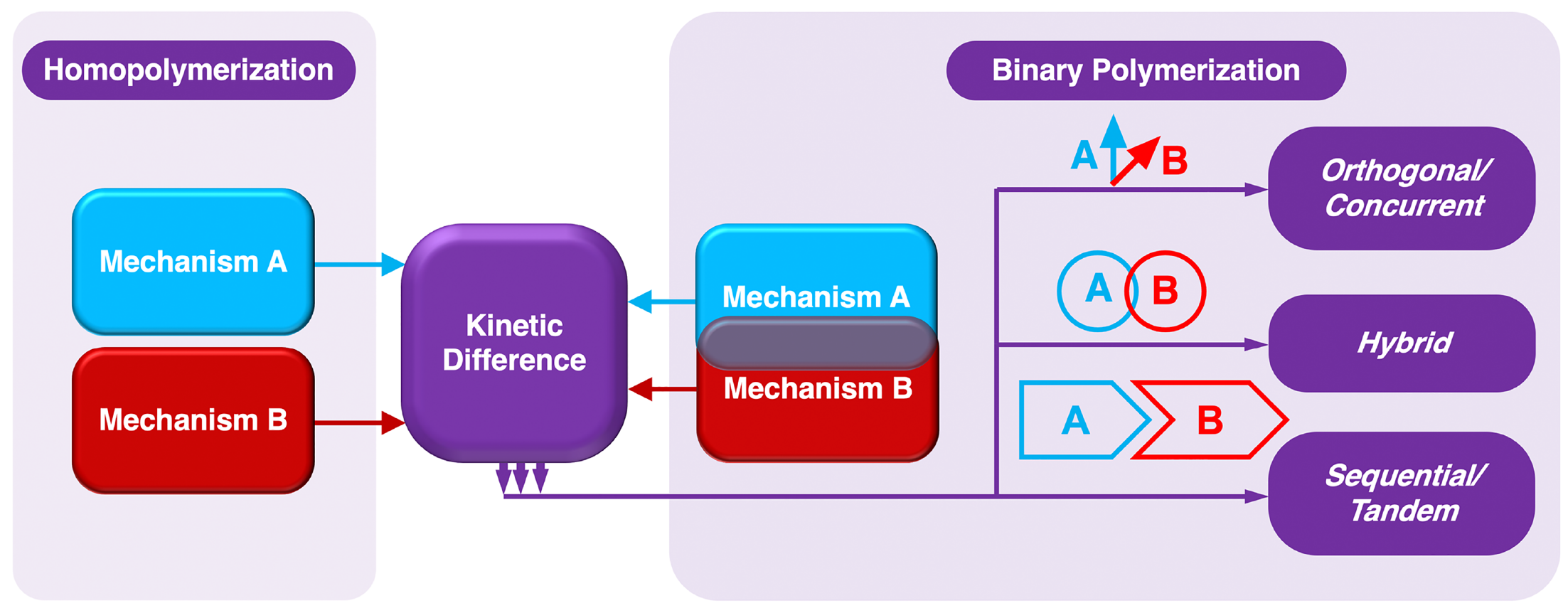
Polymerizations with multiple mechanisms performed simultaneously are promising but very challenging. As the key limitation, the complicated mutual influence between different mechanisms can be hardly defined and measured. Herein we establish a universal framework for the assessment of mutual influence between different mechanisms using binary polymerization for demonstration. The kinetics and thermodynamics of polymerization with two mechanisms are compared with the corresponding homopolymerization and the difference is expressed by a hybrid function.
The hybrid function is composed of a hybrid parameter that describes the extent of mutual influence and a function that describes necessary conditions for mutual influence to occur. The extent of mutual influence can be calculated using kinetic and thermodynamic data without details of reaction mechanisms, for the first time providing a straightforward method to assess the mutual influence between different polymerization mechanisms. We envision that the method has potential in more complex systems with multiple mechanisms/monomers with mutual influence.