Polarization-guided diffusion prior for eyeglass reflection removal
偏振引导扩散先验用于去除眼镜反光
偏航誘導拡散事前情報による眼鏡反射除去
편광 가이드 확산 프리어를 이용한 안경 반사 제거
Prior de difusión guiada por polarización para la eliminación de reflejos en gafas
Prior de diffusion guidée par polarisation pour l'élimination des reflets des lunettes
Поляризационно-направленный диффузионный приоритет для удаления отражений от очков
Yating Chen 陈雅婷, Liangcai Cao 曹良才
State Key Laboratory of Precision Measurement Technology and Instruments, Department of Precision Instruments, Tsinghua University, Beijing 100084, China
中国 北京 清华大学精密仪器系 精密测试技术及仪器全国重点实验室
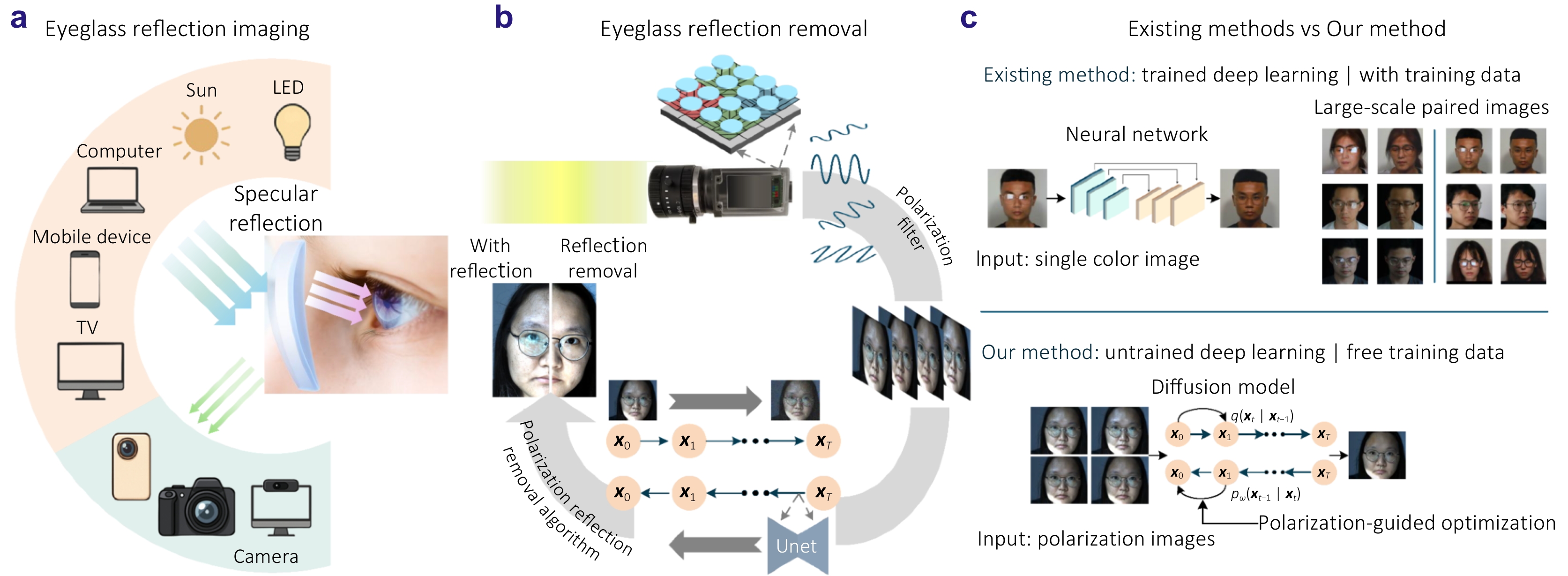
In video conferencing and facial recognition applications, eyeglass reflection often obscures critical facial features. Polarization information helps disentangle reflection and transmission components. Existing polarization reflection removal approaches rely on large-scale paired polarization datasets, making them hard to generalize to the scenes under unseen lighting conditions.
To address these challenges, we propose PDPrior, an untrained polarization-guided diffusion prior for eyeglass reflection removal. The PDPrior requires no training data, and no ground-truth reflection-free images. It operates solely on polarization observations collected at test time to achieve artifact-free, high-fidelity reflection removal. The PDPrior leverages the generative prior of a diffusion model and introduces polarization as guidance to control the generation process.
The self-supervised loss based on the forward model is employed to alternately update the reflection and transmission variables, endowing the generative model with physical interpretability. Extensive experimental results validate the effectiveness and robustness of the method on eyeglass reflection data captured in both indoor and outdoor lighting conditions, achieving higher face image quality assessment scores for recognition performance compared to state-of-the-art methods.