Thin-film lithium niobate-based detector: recent advances and perspectives
基于铌酸锂薄膜的探测器:最新进展与展望
薄膜リチウムニオブ酸塩ベースの検出器:最近の進展と展望
박막 리튬 나이오베이트 기반 검출기: 최근 발전과 전망
Detector basado en niobato de litio de película delgada: avances recientes y perspectivas
Détecteur à base de niobate de lithium en film mince : avancées récentes et perspectives
Пленочный детектор на основе литий-ниобатных пленок: последние достижения и перспективы
Xiaoli Sun 孙晓莉, Yuechen Jia 贾曰辰, Feng Chen 陈峰
School of Physics, State Key Laboratory of Crystal Materials, Shandong University, Jinan 250100, China
中国 济南 山东大学物理学院 晶体材料全国重点实验室
Thin-film lithium niobate (TFLN) has emerged as a powerful platform for integrated photonics, offering outstanding electro-optic, nonlinear optical, and ferroelectric properties. These unique material characteristics have opened new opportunities for developing high-performance photodetectors with broad spectral response, high sensitivity, and compact integration.
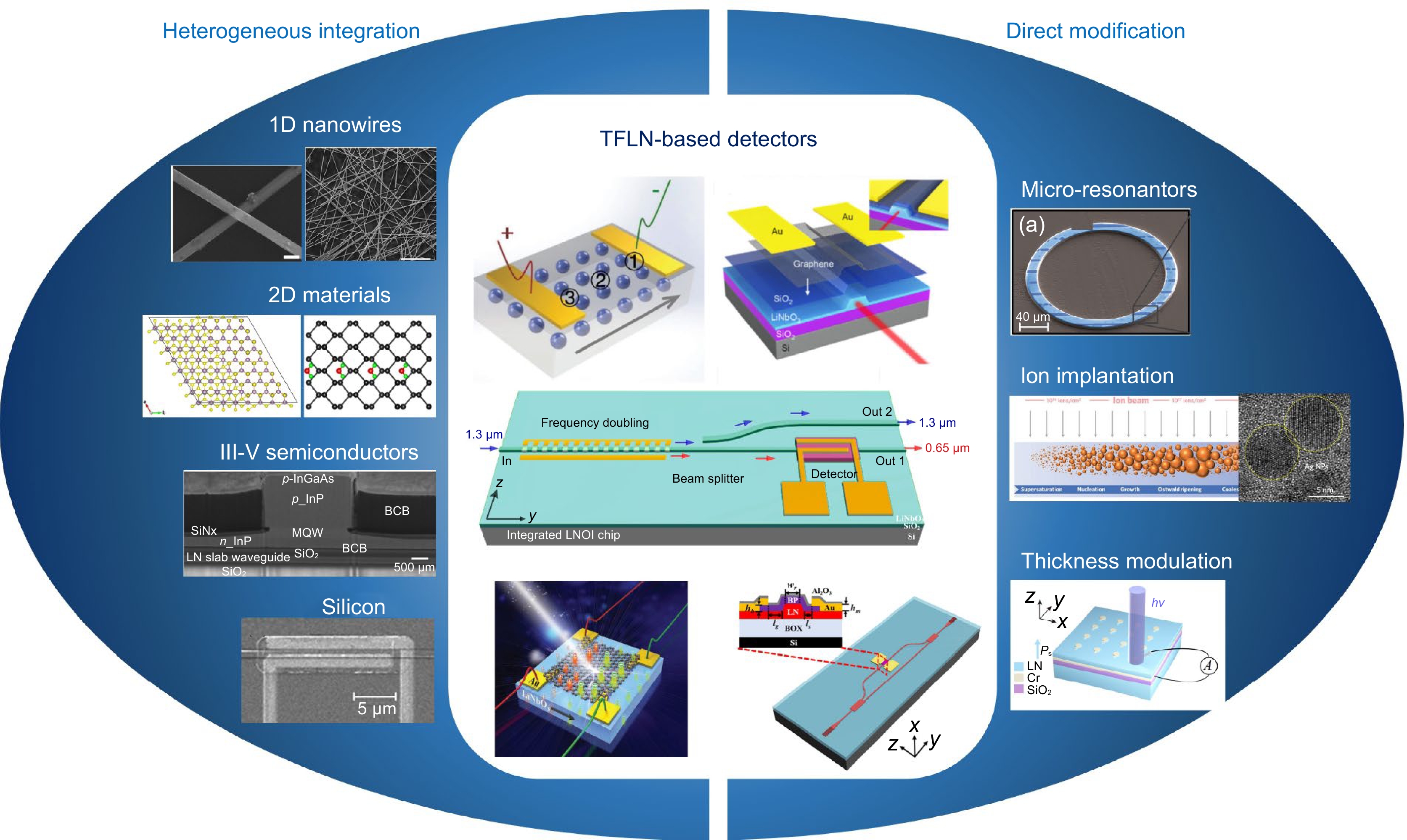
This review provides a comprehensive overview of recent progress in TFLN-based detectors, focusing on the underlying physical mechanisms and diverse device architectures. We first discuss the spontaneous polarization, bulk photovoltaic effect, and pyroelectric effect and frequency up-conversion in lithium niobate, which enable unconventional light-to-electricity conversion without external bias. Then, we introduce heterogeneously integrated photodetectors that combine TFLN with III-V semiconductors, silicon, and two-dimensional materials, under both free-space illumination and waveguide coupling configurations. We further highlight advances in integrating single-photon detectors on TFLN platforms, a key step toward scalable quantum photonic systems.
In addition, we discuss the direct modification strategies such as ferroelectric domain engineering, doping, and ion implantation modification to enhance the photodetection performance of TFLN devices. Finally, we summarize the existing challenges and present perspectives on the future development of multifunctional, low-power, and quantum-compatible photodetectors based on the TFLN platform.