Propensity score matching study of 325 patients with spontaneous rupture of hepatocellular carcinoma
325例肝癌自发性破裂患者的倾向评分匹配研究
肝細胞癌の自然破裂を伴う325人の患者の傾向スコアマッチング研究
간세포암의 자연파열 환자 325명을 대상으로 한 성향점수 매칭 연구
Estudio de emparejamiento por puntuación de propensión de 325 pacientes con rotura espontánea de carcinoma hepatocelular
Étude d'appariement par score de propension de 325 patients présentant une rupture spontanée de carcinome hépatocellulaire
Исследование сопоставления оценок предрасположенности 325 пациентов со спонтанным разрывом гепатоцеллюлярной карциномы
Wei Wang 王伟 ¹, Tao Meng ¹, Ying Chen ¹, Ye-Chuan Xu 许业传 ¹, Yi-Jun Zhao 赵义军 ¹, Yan Zhang ¹, Ming-Ya Yang ¹, Zhi-Hua Zhang 张志华 ², Fan Huang 黄帆 ¹, Hong-Chuan Zhao 赵红川 ¹, Xiao-Ping Geng 耿小平 ¹, Li-Xin Zhu 朱立新 ¹
¹ Department of General Surgery, the First Affiliated Hospital of Anhui Medical University, Hefei, China
中国 合肥 安徽医科大学第一附属医院普外科
² Department of Statistics, Anhui Medical University, Hefei, China
中国 合肥 安徽医科大学 流行病与卫生统计学系
Hepatobiliary Surgery and Nutrition, 2 June 2021 (accepted)
Background: This study aims to find out the possible optimal therapy and assess the prognosis properly for patient with spontaneous rupture of hepatocellular carcinoma (HCC).
Methods: Propensity score matching (PSM) analysis was used to study the data from 325 patients with ruptured HCC (RHCC) and 2,291 patients with non-RHCC.
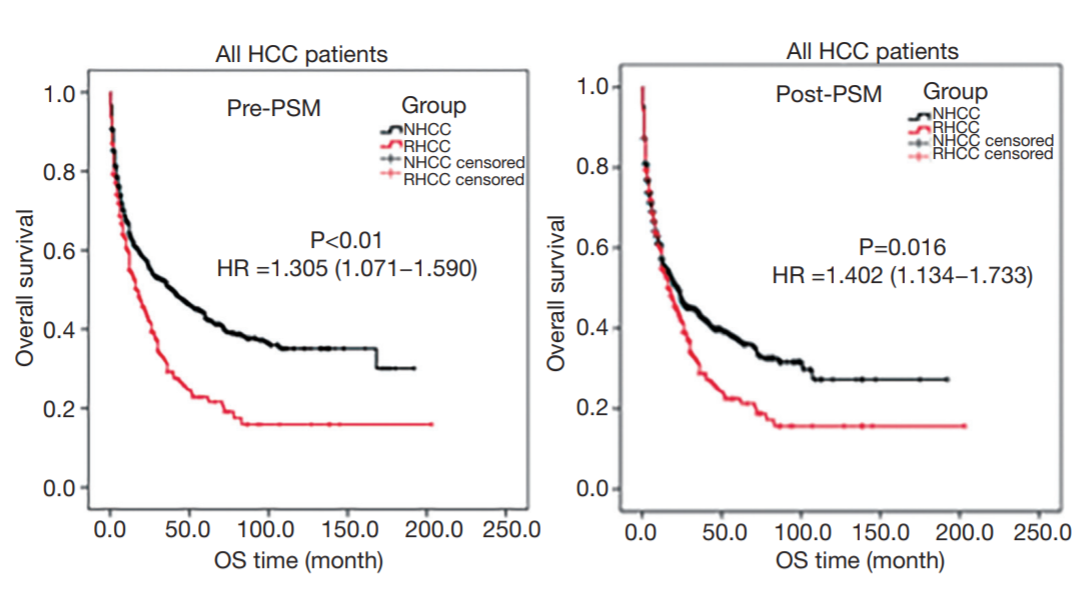
Results: The incidence and hospital mortality of RHCC were 5.1% and 0.8% respectively, with a median overall survival (OS) time of 17 months. There was no difference between ruptured and non-RHCC patients undergoing conservation treatment in terms of OS. Trans-arterial embolization (TAE) was carried out in 69 (21.2%) cases with RHCC, with a median OS of 7 months, which was no difference from that of non-RHCC (pre- and post-PSM). One hundred and sixty-nine (52.0%) RHCC cases underwent one-stage hepatectomy, with a median OS and disease-free survival (DFS) of 30 and 6 months respectively, which were shorter than that of non-RHCC (post-PSM). TAE plus two-stage hepatectomy was performed in 30 RHCC cases, with a median OS and DFS of 28 and 10 months respectively; these outcomes were better than that from RHCC patients undergoing TAE alone or one-stage hepatectomy (post-PSM), which were no difference from that of non-RHCC patients undergoing hepatectomy. The risk of death for RHCC patient undergoing one-stage hepatectomy is 1.545 times higher than that of one undergoing TAE + two-stage hepatectomy.
Conclusions: TAE plus two-stage hepatectomy might be the optimal treatment for RHCC patient. Under the premise of the same pathological properties, there is no difference in prognosis between ruptured and non-RHCC patients if the therapy is appropriate.