Advanced applications of pulsed laser deposition in electrocatalysts for hydrogen-electric conversion systems
脉冲激光沉积在氢-电转换系统电催化剂中的高级应用
水素電気変換システムにおける電気触媒へのパルスレーザー堆積の高度応用
펄스 레이저 증착 기술의 수소-전기 변환 시스템용 전기 촉매에서의 고급 응용
Aplicaciones avanzadas de la deposición por láser pulsado en electrocatalizadores para sistemas de conversión hidrógeno-eléctrico
Applications avancées de la pulvérisation laser pulsée dans les électrocatalyseurs pour les systèmes de conversion hydrogène-électricité
Продвинутые применения импульсной лазерной абляции в электрохимических катализаторах для систем преобразования водорода в электроэнергию
Yuanyuan Zhou 周圆圆 ¹ ³, Yong Wang 王勇 ¹, Ke Zhang 张科 ¹, Huaqian Leng 冷华倩 ¹, Peter Müller-Buschbaum ², Nian Li 李念 ¹ ², Liang Qiao 乔梁 ¹
¹ School of Physics, University of Electronic Science and Technology of China, Chengdu 611731, China
中国 成都 电子科技大学物理学院
² Technical University of Munich, TUM School of Natural Sciences, Department of Physics, Chair for Functional Materials, James-Franck-Str. 1, Garching 85748, Germany
³ Chongqing University of Technology, College of Chemistry & Chemical Engineering, Chongqing 400054, China
中国 重庆 重庆理工大学化学化工学院
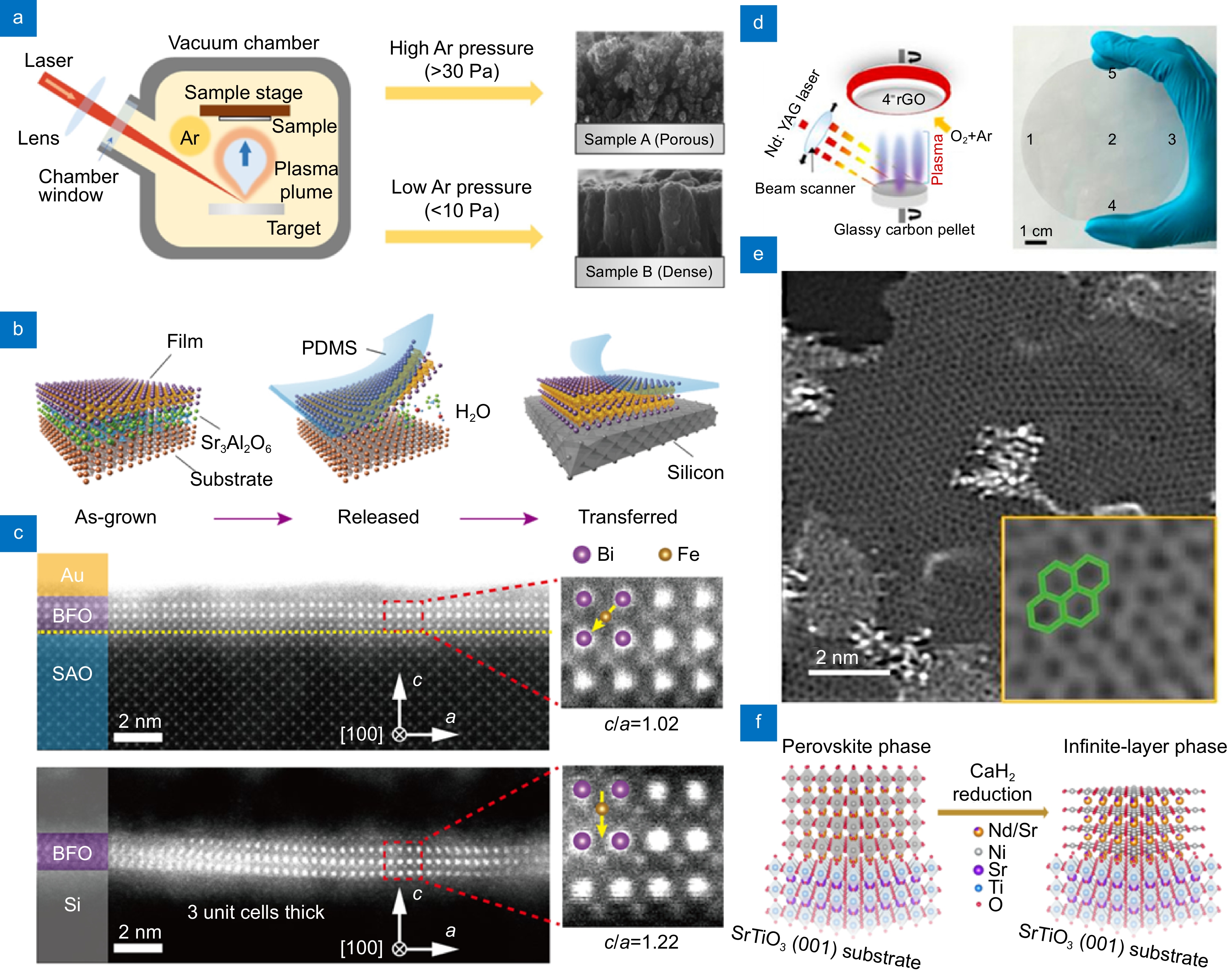
Pulsed laser deposition (PLD), as an advanced synthesis technology with unparalleled control over thin films, has evolved into a universal platform for optoelectronic materials engineering. Its unique advantages including precise stoichiometric transfer, heterogeneous structure preparation and in-situ monitoring enable the design of opto-electrocatalysts with controllable active sites.
Traditional methods struggle to pinpoint active sites in hydrogen technologies such as fuel cells and water electrolysis, impeding catalyst customization and mechanistic understanding. Nevertheless, PLD remains underused here despite its outstanding performances in targeted photo-assisted electrocatalysts design. This review systematically explores the breakthrough achievements and provides detailed insights into photo-enhanced water electrolysis and fuel cells based on PLD. Beginning with the fundamentals of epitaxial film growth and film classification, particularly emphasis the related in situ optical analysis techniques.
It subsequently highlights recent advances in electro-oxidation and reduction reactions of H2 and O2, demonstrating the control capabilities of PLD in precisely correlating the structure and activity at the atomic level. Finally, the review concludes by proposing scalable fabrication strategies and performance optimization frameworks to bridge fundamental insights with industrial-scale optoelectronic integration systems.