部分相干光芯片实现物理层公钥加密
部分的にコヒーレントな光学チップが物理層における公開鍵暗号化を可能にする
부분적으로 일관된 광학 칩이 물리 계층 공개 키 암호화를 가능하게 한다
El chip óptico parcialmente coherente permite el cifrado de clave pública en la capa física
La puce optique partiellement cohérente permet le chiffrement à clé publique au niveau physique
Частично когерентная оптическая микросхема позволяет осуществлять шифрование с открытым ключом на физическом уровне
¹ Wuhan National Laboratory for Optoelectronics, School of Optical and Electronic Information, Huazhong University of Science and Technology, Wuhan 430074, China
中国 武汉 华中科技大学光学与电子信息学院 武汉光电国家研究中心
² College of Science, National University of Defense Technology, Changsha 410073, China
中国 长沙 中国人民解放军国防科技大学理学院
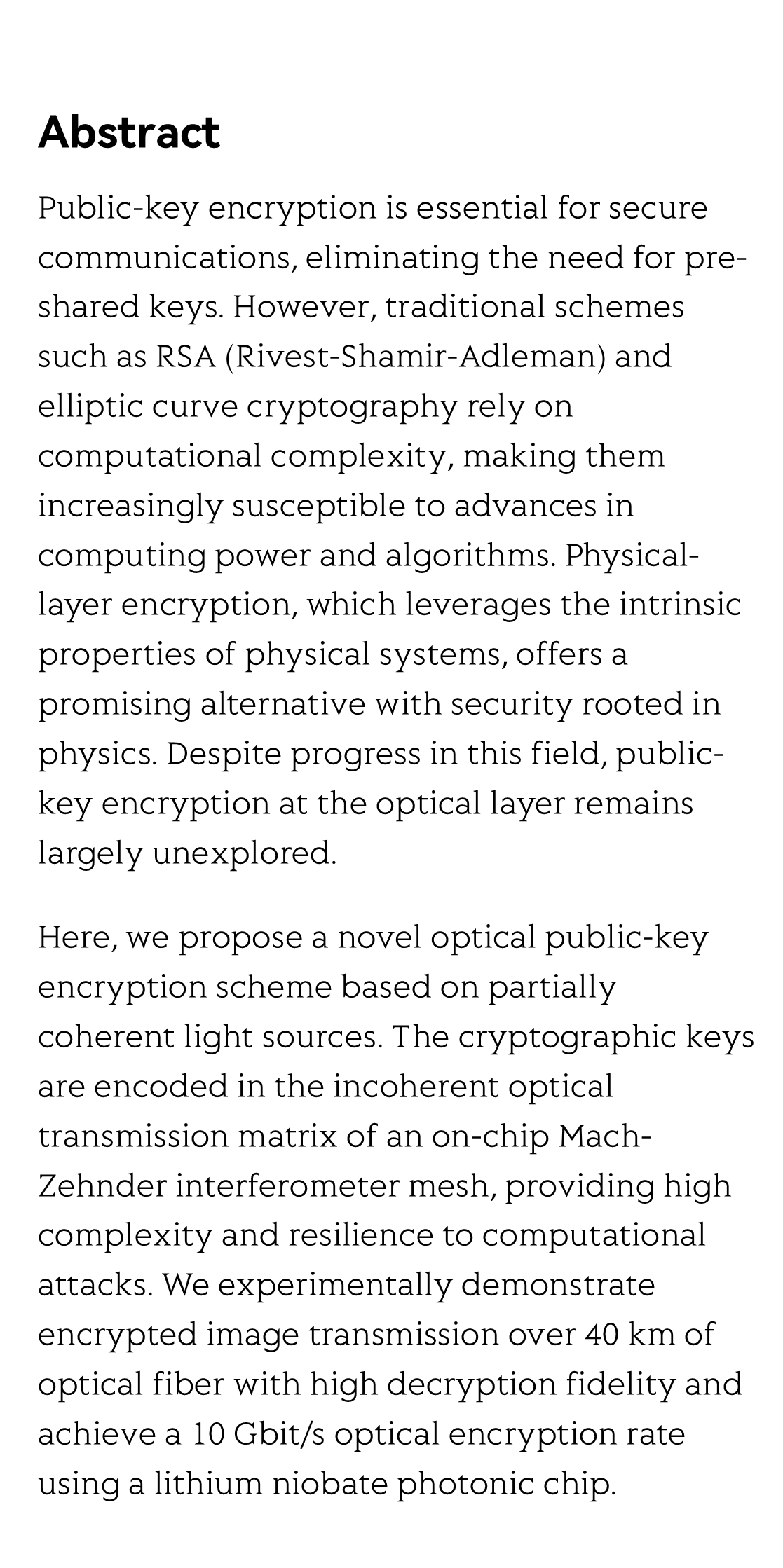
Public-key encryption is essential for secure communications, eliminating the need for pre-shared keys. However, traditional schemes such as RSA (Rivest-Shamir-Adleman) and elliptic curve cryptography rely on computational complexity, making them increasingly susceptible to advances in computing power and algorithms. Physical-layer encryption, which leverages the intrinsic properties of physical systems, offers a promising alternative with security rooted in physics. Despite progress in this field, public-key encryption at the optical layer remains largely unexplored.
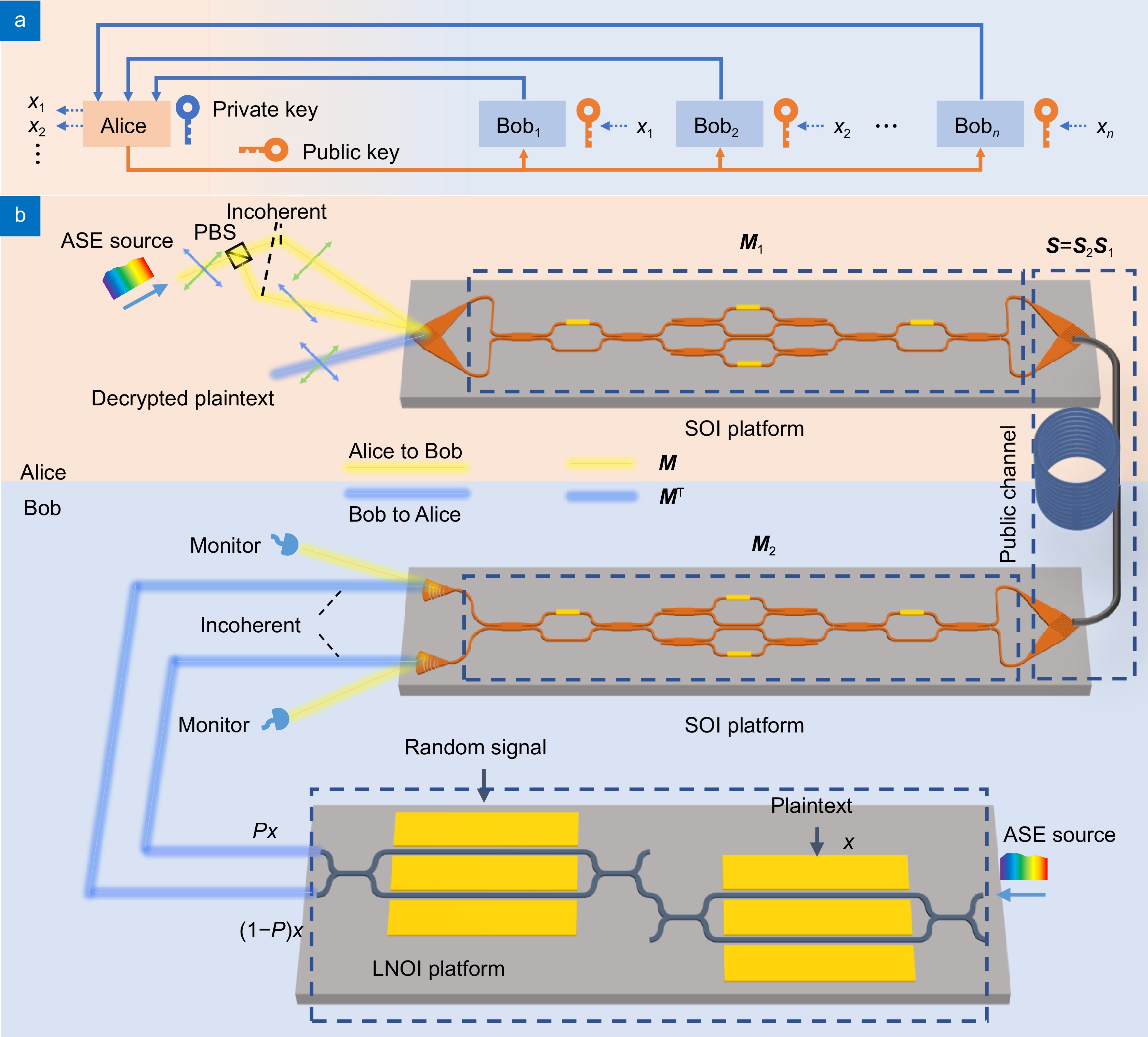
Here, we propose a novel optical public-key encryption scheme based on partially coherent light sources. The cryptographic keys are encoded in the incoherent optical transmission matrix of an on-chip Mach-Zehnder interferometer mesh, providing high complexity and resilience to computational attacks. We experimentally demonstrate encrypted image transmission over 40 km of optical fiber with high decryption fidelity and achieve a 10 Gbit/s optical encryption rate using a lithium niobate photonic chip.
This represents the first implementation of public-key encryption at the physical optical layer. The approach offers key advantages in security, cost, energy efficiency, and compatibility with commercial optical communication systems. By integrating public-key encryption into photonic hardware, this work opens a new direction for secure and high-speed optical communications in next-generation networks.