High-speed and large-capacity visible light communication for 6G: advances and perspectives
6G高速大容量可见光通信:进展与展望
6G向け高速大容量可視光通信:進展と展望
6G를 위한 고속 대용량 가시광선 통신: 발전과 전망
Comunicaciones ópticas visibles de alta velocidad y gran capacidad para el 6G: avances y perspectivas
Communication optique visible haute vitesse et à grande capacité pour la 6G : avancées et perspectives
Высокоскоростные и высокопроизводительные видимые световые коммуникации для 6G: достижения и перспективы
Nan Chi 迟楠 ¹ ² ³, Zhilan Lu 卢芝蓝 ¹, Fujie Li 李甫杰 ¹, Haoyu Zhang 张昊宇 ¹, Yunkai Wang 汪昀楷 ¹, Xinyi Liu 刘心怡 ¹, Zhiwu Chen 陈志武 ¹, Zhe Feng 冯哲 ¹, Zhuoran Hu 胡卓然 ¹, Zhixue He 贺志学 ⁴, Ziwei Li 李子薇 ¹, Chao Shen 沈超 ¹, Junwen Zhang 张俊文 ¹
¹ Key Laboratory for the Information Science of Electromagnetic Waves (MoE), College of Future Information Technology, Fudan University, Shanghai 200433, China
中国 上海 复旦大学未来信息创新学院 电磁波信息科学教育部重点实验室
² Shanghai Engineering Research Center of Low-Earth-Orbit Satellite Communication and Applications, Shanghai 200433, China
中国 上海 上海低轨卫星通信与应用工程技术研究中心
³ Shanghai Collaborative Innovation Center of Low-Earth-Orbit Satellite Communication Technology, Shanghai 200433, China
中国 上海 上海市低轨卫星通信技术协同创新中心
⁴ Peng Cheng Laboratory, Shenzhen 518055, China
中国 深圳 鹏城实验室
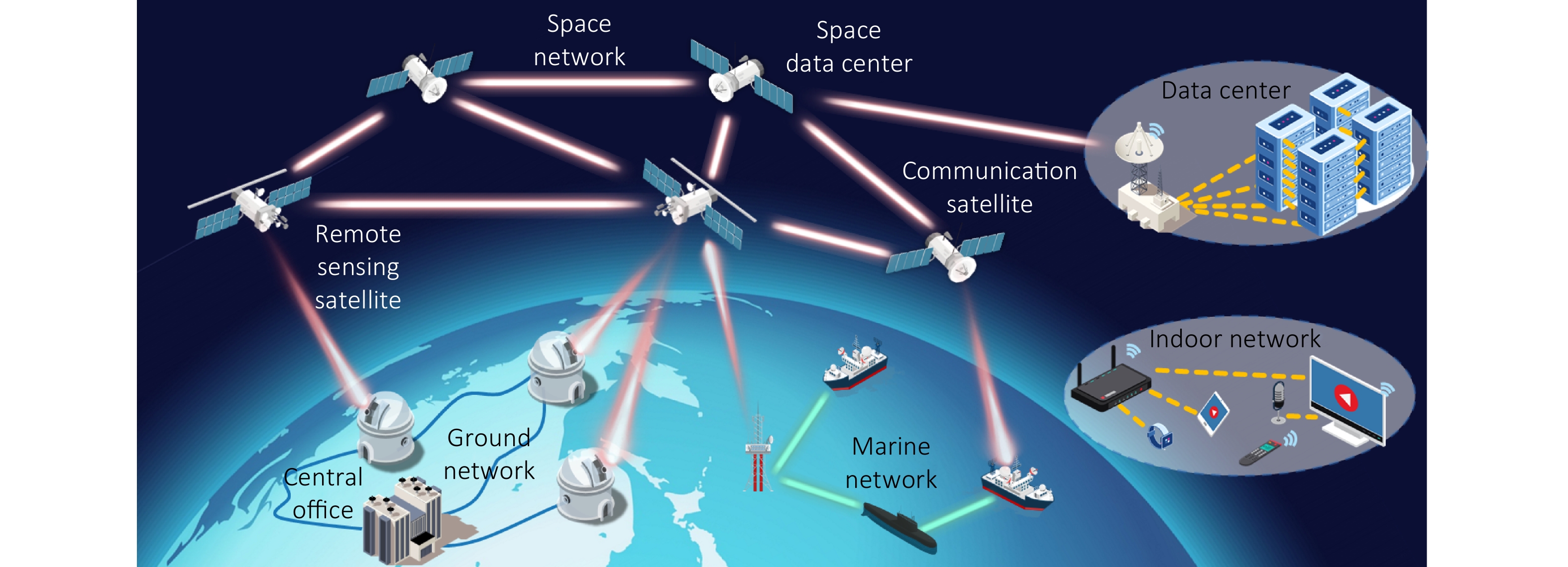
The sixth generation (6G) of mobile communications aims to establish high-speed, large-capacity space-air-ground-sea integrated networks (SAGSINs) to support the rapidly growing data traffic driven by big data and large-scale artificial intelligence. Visible light communication (VLC), operating in the 380–780 nm spectrum, has emerged as a promising optical wireless technology owing to its abundant spectral resources, high achievable data rates, and immunity to electromagnetic interference. These advantages make VLC a strong candidate for three-dimensional integrated communication networks.
This review summarizes recent advances in visible light communication, focusing on key enabling technologies including transmitter and receiver devices, advanced signal processing algorithms, multi-aperture reception, and beamforming techniques. Representative demonstrations of large-capacity VLC systems based on multi-dimensional multiplexing are reviewed. Finally, the challenges and future research directions of VLC are discussed.