Integrated optical transceivers: architectures, key technologies, and applications
集成光收发器:架构、关键技术及应用
統合光トランシーバー:アーキテクチャ、キーテクノロジー、および応用
통합 광 트랜시버: 아키텍처, 핵심 기술 및 응용 분야
Transceptores ópticos integrados: arquitecturas, tecnologías clave y aplicaciones
Récepteurs optiques intégrés : architectures, technologies clés et applications
Интегрированные оптические трансиверы: архитектуры, ключевые технологии и применения
Peng Yan 严鹏 ¹ ² ³, Yunhao Zhang 张云皓 ¹ ² ³, Yuansheng Tao 陶源盛 ⁴, Lei Wang 王磊 ², Haowen Shu 舒浩文 ³ ⁵, Xingjun Wang 王兴军 ¹ ² ³ ⁵
¹ Peking University Shenzhen Graduate School, Peking University, Shenzhen 518055, China
中国 深圳 北京大学深圳研究生院
² Peng Cheng Laboratory, Shenzhen 518055, China
中国 深圳 鹏城实验室
³ State Key Laboratory of Photonics and Communications, School of Electronics, Peking University, Beijing 100871, China
中国 北京 北京大学电子学院 光子传输与通信全国重点实验室
⁴ Department of Electrical Engineering & State Key Laboratory of Terahertz and Millimeter Waves, City University of Hong Kong, Hong Kong 999077, China
中国 香港 香港城市大学电机工程系 太赫兹及毫米波全国重点实验室
⁵ Frontiers Science Center for Nano-optoelectronics, Peking University, Beijing 100871, China
中国 北京 北京大学纳光电子前沿科学中心
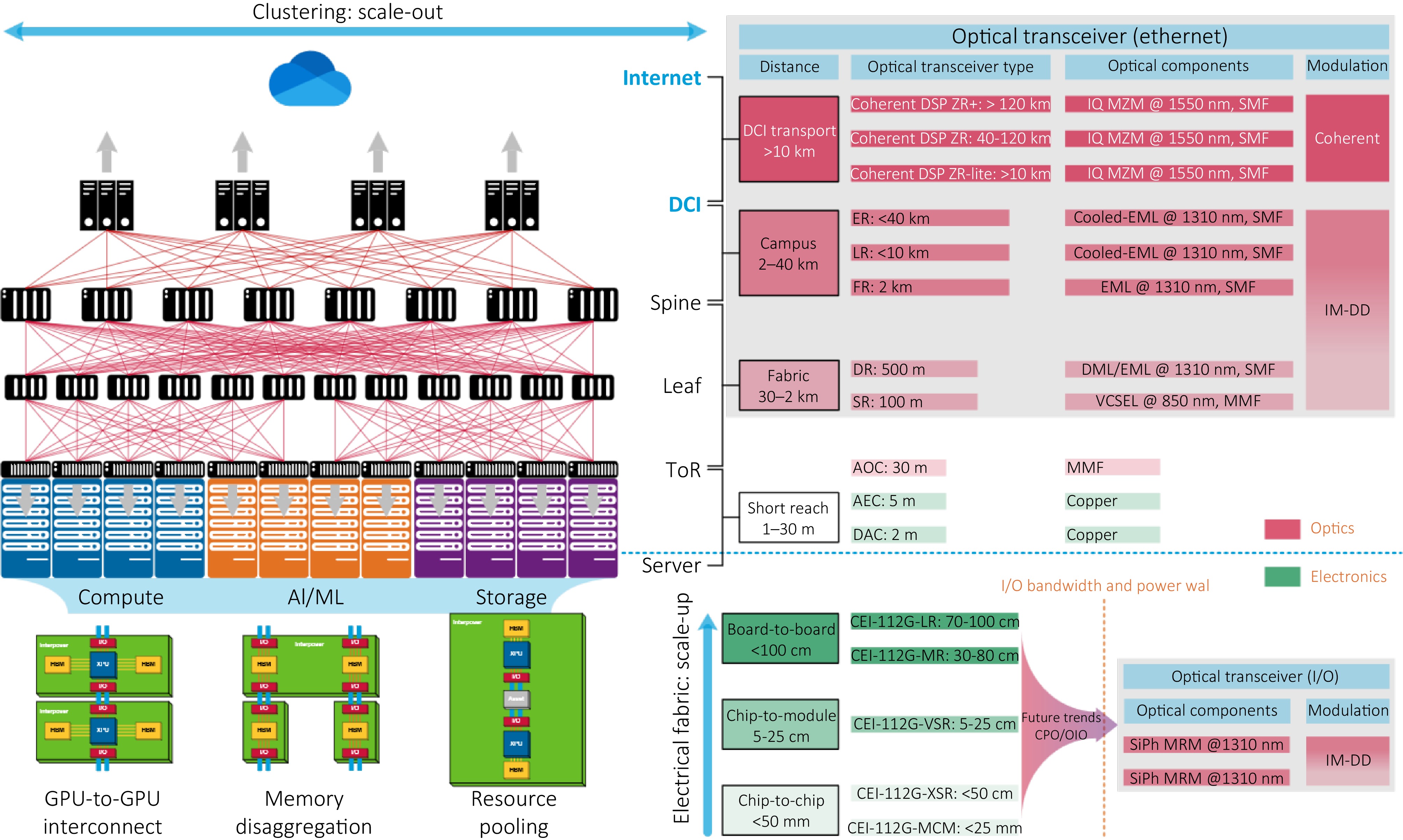
As electrical I/O approaches inherent bottlenecks in reach, energy efficiency, and bandwidth density, integrated optical transceivers are becoming critical enablers for scaling data center and accelerator interconnects. In this review, we systematically explore their development through three aspects: transceiver architectures, key enabling technologies, and target applications.
At the architectural level, we outline the entire integration-driven progression trend of optical transceivers, from pluggable modules to co-packaged optics and chiplet-based engines. Regrading key implemented technologies, we survey various commonly employed optical transmitter solutions, in which the key modulation components are severally vertical-cavity surface-emitting laser (VCSEL), electro-absorption modulated laser (EML), Mach-Zehnder modulator (MZM) and microring modulators; optical receiver schemes based on single and balanced photodetectors; as well as the associated electronic CMOS/SiGe driver and transimpedance amplifier (TIA) circuits. Currently, optical transceivers already serve as essential components in data center and high-performance computing (HPC) fabrics, high-bandwidth memory and accelerator links.
They could also support other emerging computing, sensing, and communication applications in near future, including short-reach free-space links, IoT/edge systems, autonomous vehicles, and quantum communication. Moving forward, next-generation optical transceivers are increasingly progressing toward much higher energy efficiency, bandwidth density, and scalability, driven by the new advancements in architectural design, powerful cell devices and chiplet packaging.