Hardware-aware lightweight photonic spiking neural network for pattern classification
面向硬件的轻量级光子脉冲神经网络用于模式分类
パターン分類向けハードウェア対応軽量光子スパイキングニューラルネットワーク
하드웨어 인식 경량 광자 스파이킹 신경망을 위한 패턴 분류
Red neuronal de fotones con disparos ligera y consciente del hardware para clasificación de patrones
Réseau de neurones photoniques à impulsions léger et conscient du matériel pour la classification de motifs
Облегченная оптическая спайкирующая нейронная сеть с учетом аппаратных возможностей для классификации образов
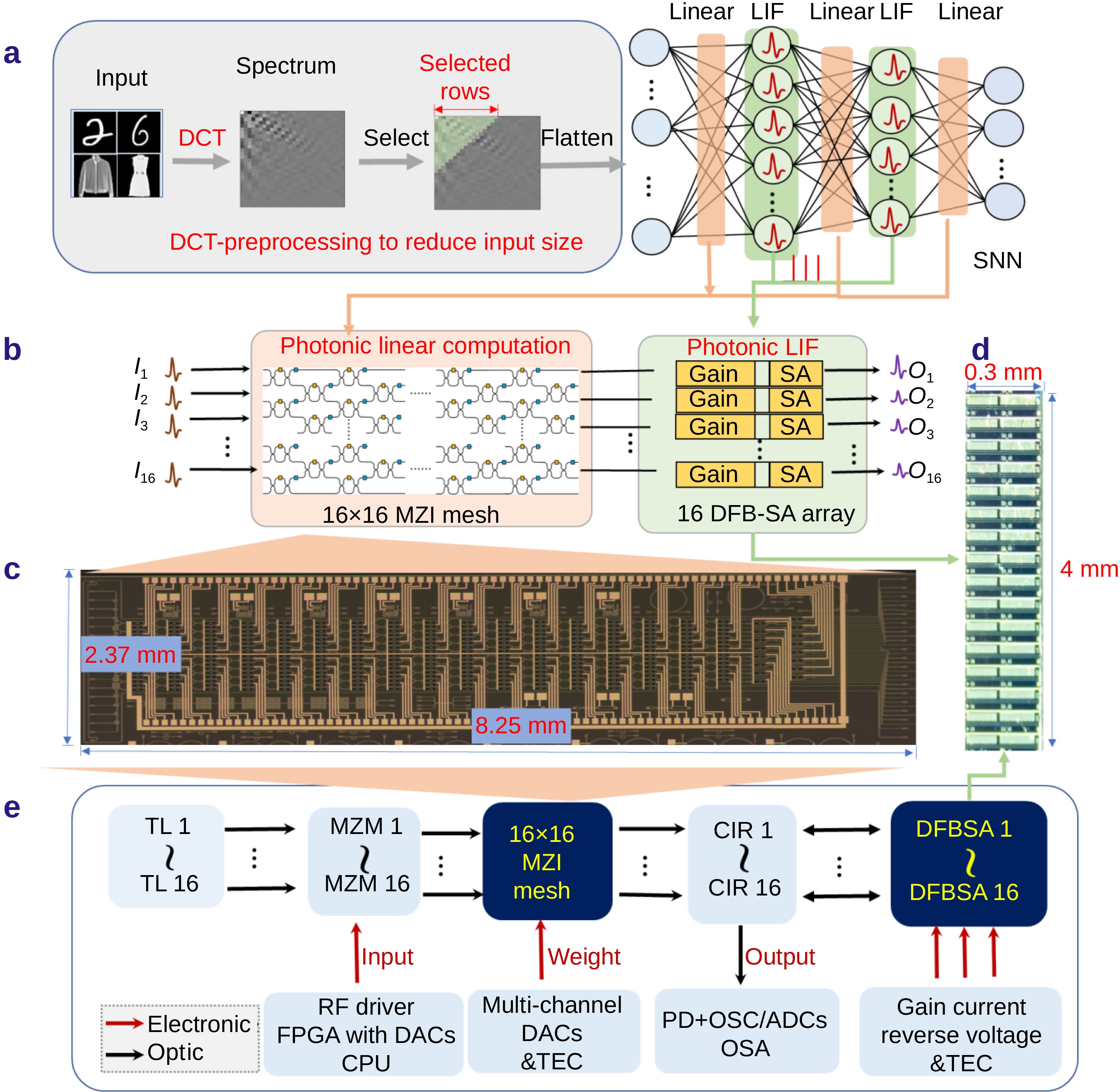
There exists a significant scale gap between photonic neural network integrated chips and neural networks, which hinders the deployment and application of photonic neural network. Here, we propose hardware-aware lightweight spiking neural networks (SNNs) architecture tailored to our photonic neuromorphic chips, and conduct hardware-software collaborative computing for solving pattern classification tasks.
We employed a simplified Mach-Zehnder interferometer (MZI) mesh for performing linear computation, and 16-channel distributed feedback lasers with saturable absorber (DFB-SA) array for performing nonlinear spike activation. Both photonic neuromorphic chips based on the MZI mesh and DFB-SA array were designed, optimized and fabricated. Furthermore, we propose a lightweight SNN with discrete cosine transform to reduce input dimension and match the input/output ports number of the photonic neuromorphic chips. We demonstrated an end-to-end inference of an entire layer of the lightweight photonic SNN.
The hardware-software collaborative inference accuracy is 90% and 80.5% for MNIST and Fashion-MNIST datasets, respectively. The energy efficiency is 1.39 TOPS/W for the MZI mesh, and is 987.65 GOPS/W for the DFB-SA array. The lightweight architecture and experimental demonstration address the challenge of scale mismatch between the photonic chip and SNN, paving the way for the hardware deployment of photonic SNNs.