Biological testing with terahertz focal-plane imaging based on a slot metamaterial sensor
基于槽缝超材料传感器的太赫兹焦平面成像生物检测
スロットメタマテリアルセンサーに基づくテラヘルツフォーカルプレーンイメージングによる生物学的試験
슬롯 메타물질 센서 기반 테라헤르츠 초점면 이미징을 이용한 생물학적 테스트
Pruebas biológicas con imágenes de plano focal en terahercios basadas en un sensor de metamaterial de ranura
Test biologique avec imagerie de plan focal térahertz basée sur un capteur métamatériau à fente
Биологическое тестирование с использованием терагерцового фокальной-плоскостного изображения на основе щелевого метаматериального сенсора
Chen Zhang 张宸 ¹, Xinke Wang 王新柯 ¹, Zehao He 何泽浩 ¹, Shuanglin Yue 岳双林 ², Baogang Quan 全保刚 ³, Huan Zhao 赵欢 ⁴, Yan Zhang 张岩 ¹
¹ Beijing Key Laboratory of Metamaterials and Devices, Key Laboratory of Terahertz Optoelectronics Ministry of Education, Department of Physics, Capital Normal University, Beijing 100048, China
中国 北京 首都师范大学物理系 超材料与器件北京市重点实验室 太赫兹光电子学教育部重点实验室
² Peking Nanofab, School of Electronics, Peking University, Beijing 100871, China
中国 北京 北京大学电子学院 微纳加工实验室
³ Beijing National Laboratory for Condensed Matter Physics, Institute of Physics, Chinese Academy of Sciences, Beijing 100190, China
中国 北京 中国科学院物理研究所 北京凝聚态物理国家实验室
⁴ School of Optics and Photonics, Beijing Institute of Technology, Beijing 100081, China
中国 北京 北京理工大学光电学院
Terahertz (THz) imaging technology has shown great application potential in biological testing due to its low photon energy and broadband spectral features. After integrating a metamaterial sensor, the THz field-biological tissue interaction is dramatically enhanced, so that image contrast is significantly improved.
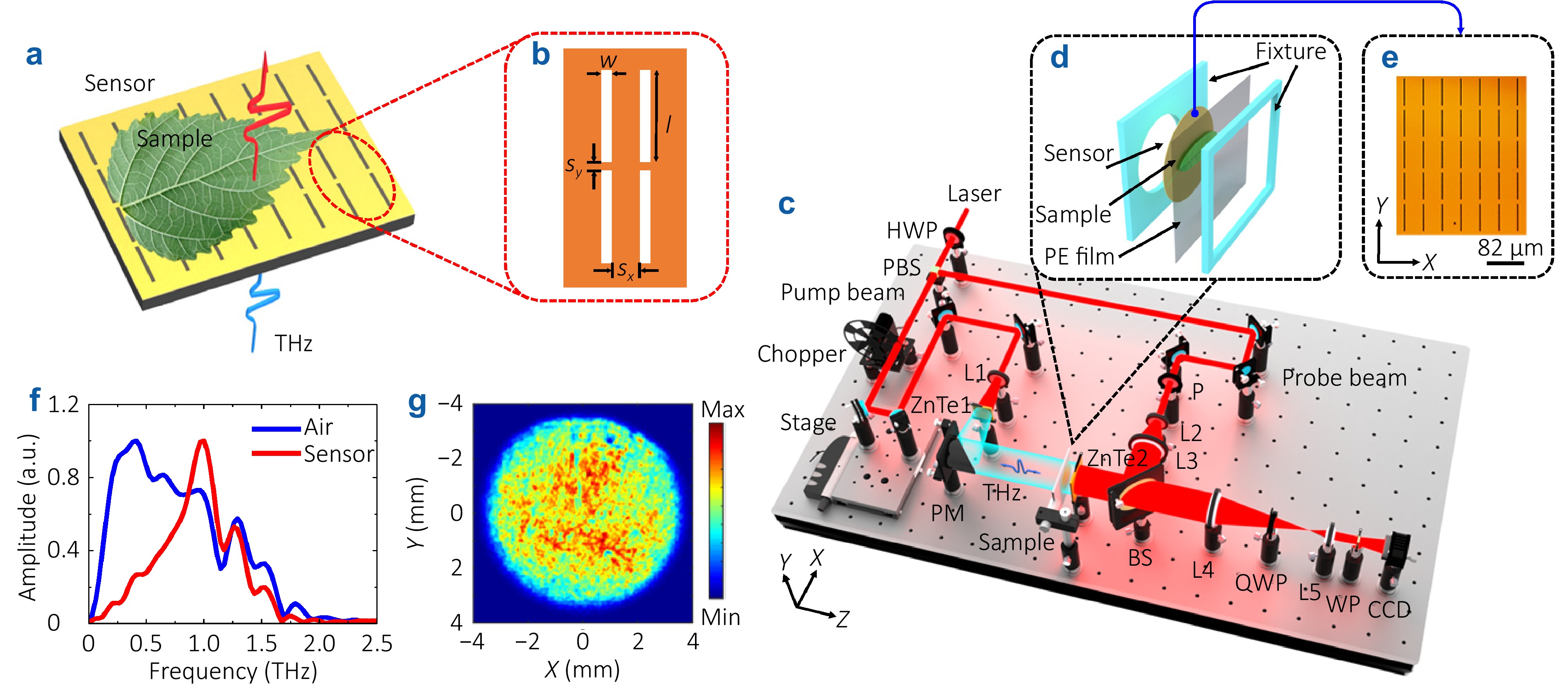
In this work, THz focal-plane biological imaging is implemented based on a metamaterial sensor composed of a slot array. By adopting this technique, THz spectral images of several plant leaves and animal tissues are obtained, achieving an approximate 3-fold enhancement in image contrast compared with those acquired using a bare silicon wafer.
Simultaneously, the focal-plane detection mode greatly reduces time consumption compared with the traditional raster-scanning mode. In addition, a deep learning algorithm is applied as a spectral classifier, which effectively segments different tissue regions and further improves image quality. This work demonstrates the application value of the technique as a biological testing platform.