Laser-induced phase transitions in 2D materials: from microscopic mechanisms to device applications
二维材料中的激光诱导相变:从微观机制到器件应用
2次元材料におけるレーザ誘起相転移:ミクロ機構からデバイス応用へ
2D 재료의 레이저 유도된 단계 전환: 현미경 메커니즘에서 장치 응용 프로그램까지
Transiciones de fase inducidas por láser en materiales 2D: desde mecanismos microscópicos hasta aplicaciones de dispositivos
Transitions de phase induites par le laser dans les matériaux 2D : des mécanismes microscopiques aux applications de dispositifs
Фазные переходы, индуцированные лазером, в 2D-материалах: от микроскопических механизмов до устройств
Yao Yao ¹ ² ³, Yinzhou Yan ³
¹ nstitute of Manufacturing Engineering, Huaqiao University, Xiamen 361021, China
中国 厦门 华侨大学制造工程研究院
² State Key Laboratory for High Performance Tools, Xiamen 361021, China
中国 厦门 高性能工具全国重点实验室
³ School of Physics and Optoelectronic Engineering, Beijing University of Technology, Beijing 100124, China
中国 北京 北京工业大学物理与光电工程学院
Two-dimensional (2D) materials exhibit a rich variety of crystal phases, which impart distinctly different electrical conductivity, optical response, and catalytic activity. This diversity makes phase engineering a core strategy for on-demand property tuning in 2D materials. To date, various phase engineering strategies have been developed, including chemical intercalation, strain engineering, and electrostatic gating.
These approaches offer distinct advantages for specific scenarios, but each is also subject to intrinsic limitations, such as the introduction of extrinsic species, restricted modulation range, or limited compatibility with fabrication processing. Laser-induced phase transition (LIPT) has emerged over the past decade as a complementary route that addresses some of these constraints. Owing to the high temporal resolution, localized energy deposition, and non-equilibrium processing capability, LIPT can drive phase transitions on timescales ranging from femtoseconds to nanoseconds, while the spatial resolution, phase purity, and long-term stability remain active areas of investigation.
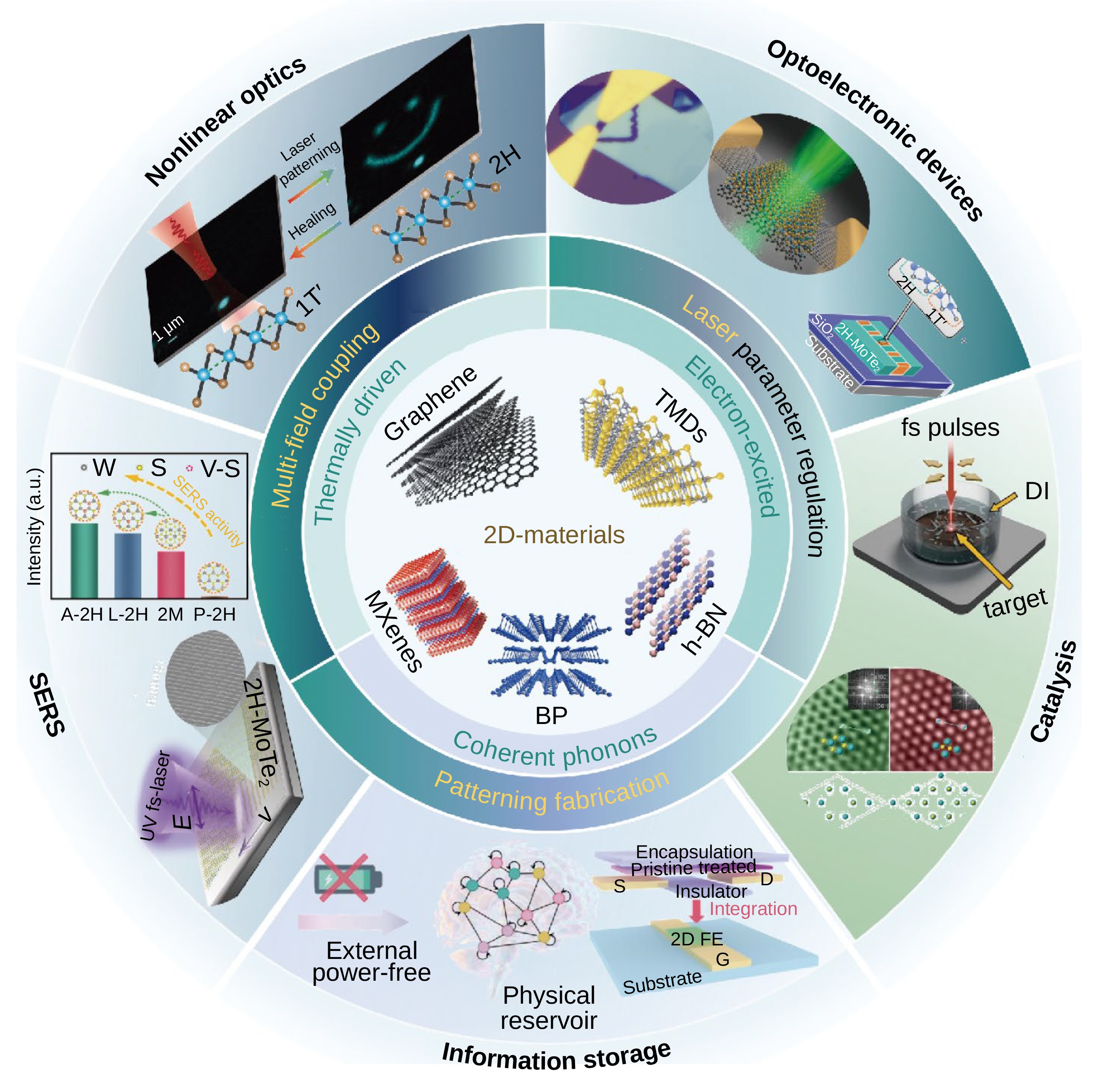
This review systematically summarizes recent advances in LIPT applied to 2D materials. The underlying mechanisms, including thermally driven, electronically excited, and coherent-phonon-mediated transitions, are discussed. The regulation strategies of LIPT in terms of optical field, field assistance, and spatial field are also systematically discussed. Finally, the cutting-edge device applications enabled by LIPT are explored in depth, by which the future developments and applications are prospected.