Luminescent YAG:Ce³⁺ 3D micro-structures via multi-photon laser lithography
通过多光子激光光刻技术制备发光YAG:Ce³⁺ 3D微结构
マルチフォトンレーザーリソグラフィによる発光性YAG:Ce³⁺ 3Dマイクロ構造
다중 광자 레이저 리소그래피를 통한 발광성 YAG:Ce³⁺ 3D 마이크로 구조체
Microestructuras 3D luminiscentes de YAG:Ce³⁺ mediante litografía láser multiphotón
Structures microscopiques 3D luminescentes YAG:Ce³⁺ par lithographie laser multiphotonique
Люминесцентные 3D-микроструктуры YAG:Ce³⁺ с помощью многофотонной лазерной литографии
¹ Faculty of Chemistry and Geosciences, Vilnius University, Naugarduko Str. 24, Vilnius LT-03225, Lithuania
² Department of Chemical Engineering and Technology, Center for Physical Sciences and Technology, Saulėtekio Ave. 3, Vilnius LT-10257, Lithuania
³ Laser Research Center, Physics Faculty, Vilnius University, Saulėtekio Ave. 10, Vilnius LT-10223, Lithuania
⁴ Department of Chemical Engineering, Mesoscale Chemical Systems, MESA+ Institute, University of Twente, P.O. Box 217, Enschede 7500 AE, Netherlands
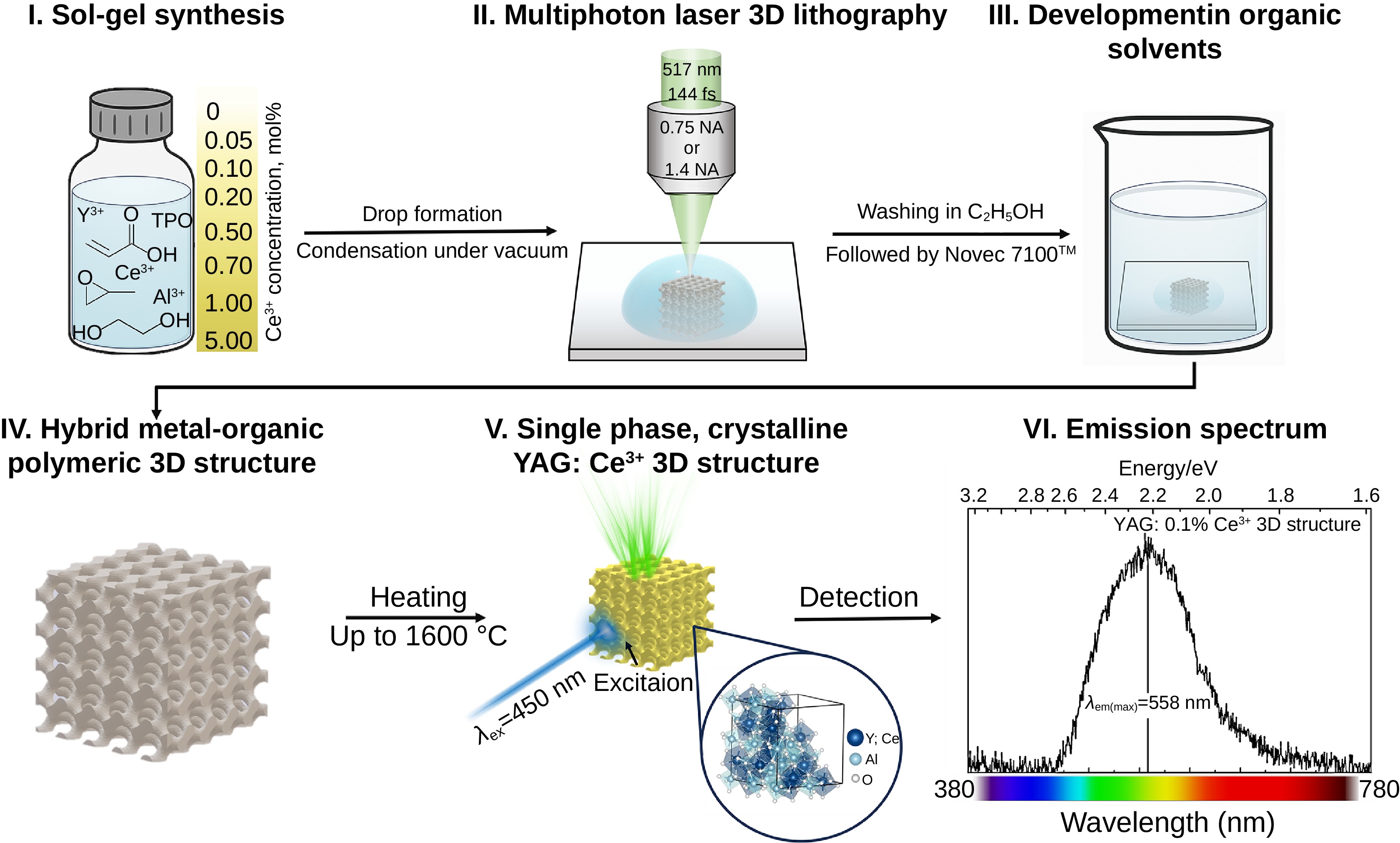
This work addresses the challenge of fabricating crystalline single-phase luminescent 3D microstructures by demonstrating a fabrication process of yttrium aluminum garnet doped with cerium (YAG:Ce³⁺) 3D micro-objects. Precursors were synthesized via a sol-gel method and characterized by refractive index (RI) measurements, Fourier-transform infrared spectroscopy (FT-IR), and thermogravimetric (TG) analysis to verify chemical composition changes during photopolymerization and thermal treatment.
Multiphoton laser 3D lithography (MP3DL) was employed to produce hybrid metal-organic 3D structures, which were subsequently converted into crystalline ceramics through controlled 3-step annealing. Structural analysis by X-ray diffraction (XRD) confirmed the formation of single-phase cubic YAG across Ce³⁺ concentrations up to 5 mol-% in 3D objects, while scanning electron microscopy (SEM) revealed isotropic shrinkage (ca. 39%) and well-preserved geometries with sub-micrometer features after pyrolysis.
The smallest feature of a crystalline 3D object achieved was 0.48 μm with a spatial resolution down to 2.4 μm. Luminescence measurements showed characteristic Ce³⁺ emission centered at 558 nm, with maximum intensity at 2 mol-% doping. These findings establish a reliable pathway to fabricate thermally stable, high-resolution, luminescent single-phase YAG:Ce³⁺ 3D micro-objects, enabling their integration into optoelectronic and photonic applications.