Scaling metasurface design: from reusable unit cells to full-metasurface inverse design
扩展元曲面设计:从可重用的晶胞到全元曲面逆向设计
拡張子サーフェス設計:再利用可能な単位胞から完全要素サーフェスへの逆設計
메타표면 설계 확장: 재사용 가능한 단위 셀에서 전체 메타표면 역설계까지
Diseño de metasuperficie a escala: desde células unitarias reutilizables hasta diseño inverso de metasuperficie completa
Conception à l'échelle de la métasurface: des cellules unitaires réutilisables à la conception inverse de la métasurface complète
Масштабирование дизайна метаповерхности: от многократно используемых единичных ячеек до полного обратного дизайна метаповерхности
Eunbi Jang ¹, Jiwan Hong ², Ho-Jun Lee ¹, Seokju Choi ³, Hyewon Suk ¹, Chanik Kang ⁴, Sunae So ² ³, Haejun Chung ¹ ⁴ ⁵
¹ Department of Artificial Intelligence Semiconductor, Hanyang University, Seoul 04763, Republic of Korea
² Department of Electro-Mechanical Systems Engineering, Korea University, Sejong 30019, Republic of Korea
³ Department of Control and Instrumentation Engineering, Korea University, Sejong 30019, Republic of Korea
⁴ Department of Artificial Intelligence, Hanyang University, Seoul 04763, Republic of Korea
⁵ Department of Electronic Engineering, Hanyang University, Seoul 04763, Republic of Korea
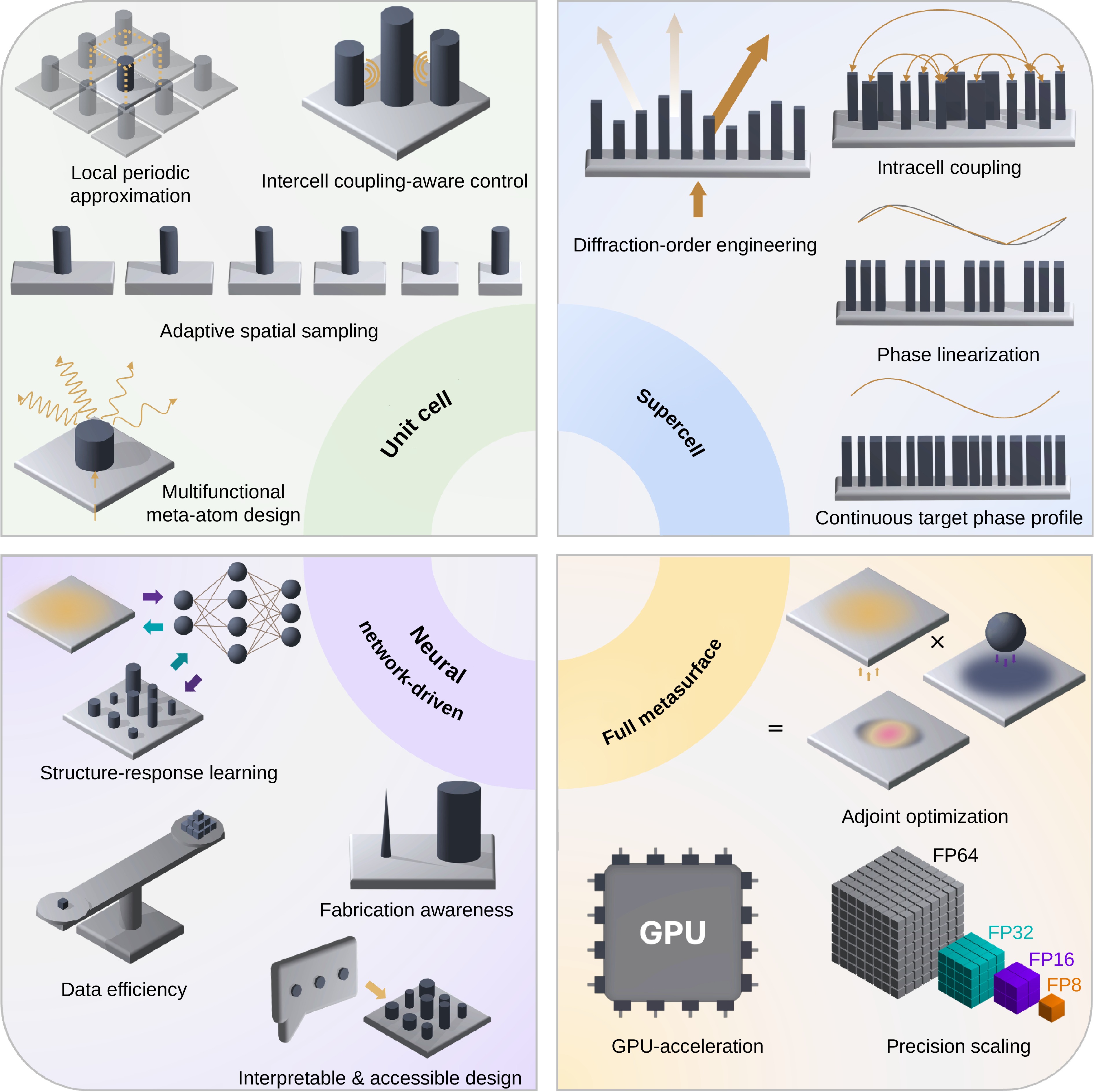
Metasurfaces enable precise control of optical phase, amplitude, and polarization within an ultrathin form factor. Yet many large-area devices are still designed by assembling unit cells characterized under the local periodic approximation, which sometimes neglects important electromagnetic interactions between dissimilar neighboring elements. Full-metasurface inverse design has recently emerged as a powerful alternative because it treats the entire aperture as a coupled electromagnetic system and directly exploits inter-element interactions.
In this review, we organize large-area metasurface design methods according to the spatial extent of the jointly optimized region, progressing from reusable unit cells to supercells and full-metasurface inverse design. We also examine neural-network-based approaches, including surrogate electromagnetic solvers, inverse design networks, and data-efficient and fabrication-aware methods. In addition, we assess whether reusable supercell designs can provide computational savings comparable to those of meta-atom libraries.
Finally, our hardware-aware scaling analysis estimates the memory and runtime required for full-wave full-metasurface optimization across a range of aperture sizes and computing systems. These results clarify the trade-off between electromagnetic accuracy and computational cost and show how advances in computing hardware may expand the practical limits of full-aperture metasurface design.