Comprehensive review of distributed acoustic sensing technology: principles, configurations, applications and emerging trends
分布式声传感技术综述:原理、配置、应用和新兴趋势
分散型音響センシング技術の概要:原理、配置、応用と新興傾向
분산 음성 감지 기술의 포괄적 인 검토: 원칙, 구성, 응용 프로그램 및 새로운 추세
Revisión integral de la tecnología de detección acústica distribuida: principios, configuraciones, aplicaciones y tendencias emergentes
Examen complet de la technologie de détection acoustique distribuée : principes, configurations, applications et tendances émergentes
Всеобъемлющий обзор технологии распределенного акустического зондирования: принципы, конфигурации, применения и новые тенденции
Arnaldo Leal-Junior ¹ ², Mariana Silveira ¹, Stanislav Kepak ³, Jan Nedoma ³, Radek Martinek ², Carlos Marques ⁴ ⁵
¹ Federal University of Espirito Santo, Fernando Ferrari Avenue, Vitoria 29075-910, Brazil
² Department of Cybernetics and Biomedical Engineering, Faculty of Electrical Engineering and Computer Science, VSB—Technical University of Ostrava, 17. listopadu 15, Ostrava 70800, Czech Republic
³ Department of Telecommunications, Faculty of Electrical Engineering and Computer Science, VSB—Technical University of Ostrava, 17. listopadu 15, Ostrava 70800, Czech Republic
⁴ CICECO, University of Aveiro, Campus Universitário de Santiago, Aveiro 3810-193, Portugal
⁵ Department of Physics, Faculty of Electrical Engineering and Computer Science, VSB—Technical University of Ostrava, 17. listopadu 15, Ostrava 70800, Czech Republic
In recent years, distributed acoustic sensing (DAS) has been a preferred choice in many practical applications due to its versatility and the possibility of using existing infrastructure. This paper presents a thorough review on DAS technology of all aspects of such sensing system.
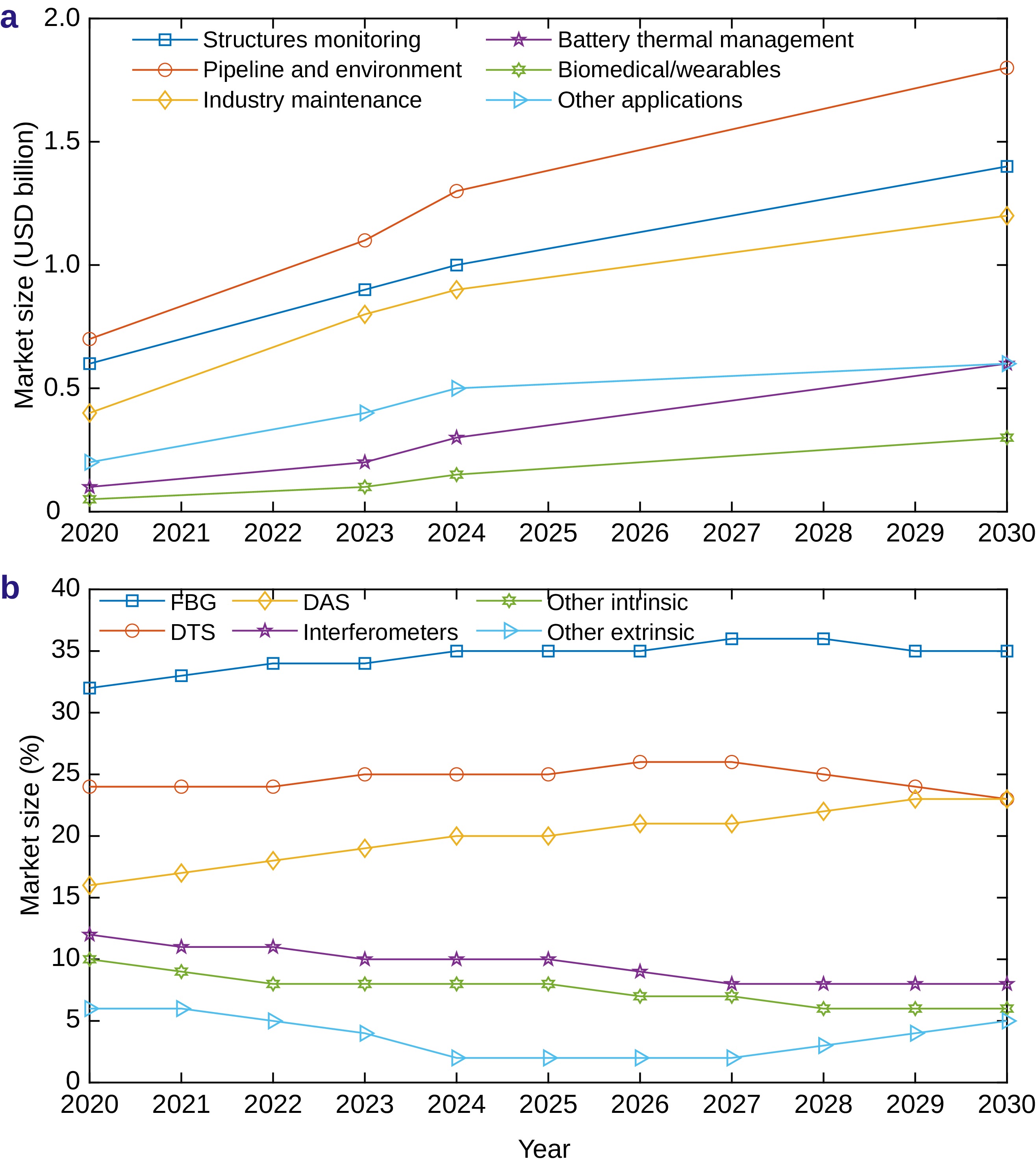
The review includes a market overview demonstrating the increasing trend in DAS market size (projected to USD 7.8 billion by 2030), focused on implementation in different fields. Then, the operation principles, fundamentals and theoretical background of the DAS systems are analyzed and compared in terms of different approaches. In addition, the myriads of DAS applications proposed in recent years are reviewed. Thereafter, current limitations and drawbacks of DAS are discussed and emerging technologies to address such drawbacks are analyzed in terms of benefits and future challenges for the next generation of DAS technology.
This review paper’s unique value is to comprehensively cover all aspects of DAS technology, from its theoretical basis and first laboratory demonstrations to practical implementation covering tens of kilometers. Such review can be used as a roadmap for DAS applications and to understand the application and implementation of ϕ-OTDR systems with critical perspective of the new possibilities of the next generation of DAS systems.