Learning from hybrid bright-dark field imaging for resolution-enhanced digital pathology
从混合亮暗场成像中学习分辨率增强的数字病理学
混合暗視野イメージングから解像度向上のためのデジタル病理学を学ぶ
해상도를 향상시키는 디지털 병리학을 위한 하이브리드 밝은 어두운 필드 이미징에서 배우기
Aprendizaje de imágenes de campo brillante-oscuro híbrido para patología digital mejorada en resolución
Apprendre à partir de l'imagerie de champ brillant-sombre hybride pour une pathologie numérique améliorée en résolution
Обучение гибридной визуализации ярко-темного поля для цифровой патологии с повышенным разрешением
Runjie Huang ¹ ² ³ ⁴, Runnan Zhang ¹ ² ³ ⁴, Xiyu Chen ¹ ² ³ ⁴, Yefeng Shu ¹ ² ³ ⁴, Wenjian Chen ³, Kun Gui ⁵, Kehui Wang ⁵, Jiasong Sun ¹ ² ³ ⁴, Juergen W. Czarske ⁶ ⁷, Chao Zuo ¹ ² ³ ⁴
¹ Smart Computational Imaging Laboratory (SCILab), School of Electronic and Optical Engineering, Nanjing University of Science and Technology, Nanjing 210094, China
中国 南京 南京理工大学智能计算成像实验室(SCILab)
² Smart Computational Imaging Research Institute (SCIRI) of Nanjing University of Science and Technology, Nanjing 210019, China
中国 南京 南京理工大学智能计算成像研究院 (SCIRI)
³ Jiangsu Key Laboratory of Spectral Imaging & Intelligent Sense Nanjing University of Science and Technology, Nanjing 210094, China
中国 南京 南京理工大学江苏省光谱成像与智能感知重点实验室
⁴ State Key Laboratory of Extreme Environment Optoelectronic Dynamic Measurement Technology and Instrument, Taiyuan 030051, China
中国 太原 极限环境光电动态测试技术与仪器全国重点实验室
⁵ Konfoong Biotech International Co., LTD, Yuyao 315400, China
中国 余姚市 宁波江丰生物信息技术有限公司
⁶ Competence Center for Biomedical Computational Laser Systems (BIOLAS), TU Dresden, Helmholtzstrasse 18, 01069 Dresden, Germany
⁷ Laboratory of Measurement and Sensor System Technique (MST), TU Dresden, Helmholtzstrasse 18, 01069 Dresden, Germany
High-throughput whole-slide imaging (WSI) confronts a trade-off between scanning speed and optical resolution, rendering low-numerical-aperture objectives inadequate for resolving critical microstructures. Computational resolution enhancement offers an alternative; however, the ill-posedness of single-image resolution enhancement leads to over-smoothed reconstructions or hallucinations, undermining clinical reliability.
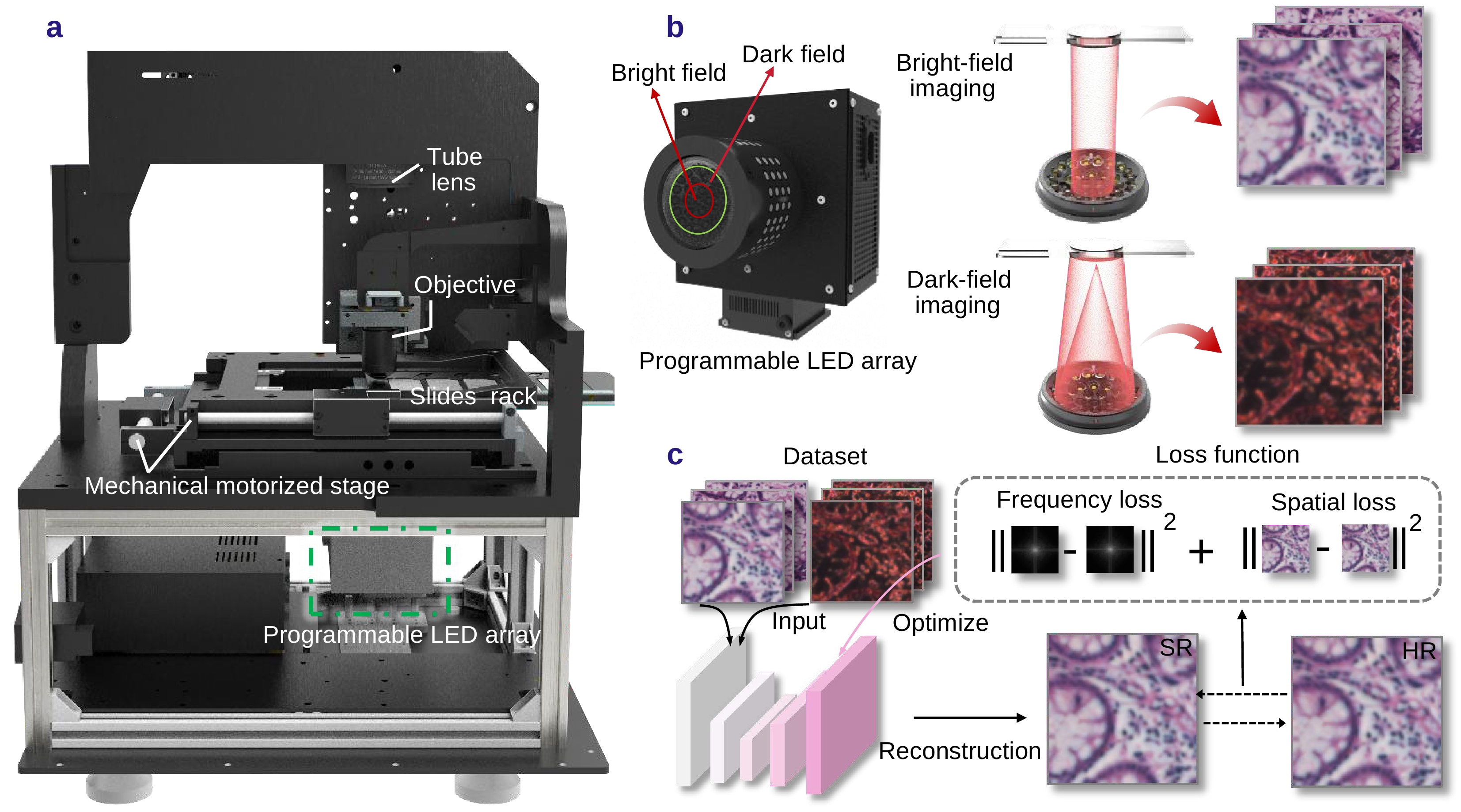
We present HBDF-RE, a hybrid bright-field and dark-field resolution enhancement framework that exploits complementary physical contrast to constrain the reconstruction problem. A single dark-field acquisition, enriched with high-frequency scattering information inaccessible to conventional bright-field imaging, serves as a reference that reduces the solution space and guides reconstruction from low-resolution bright-field inputs. HBDF-RE integrates multimodal feature fusion, spatial attention, and joint spatial-frequency domain optimization to preserve global tissue morphology while recovering fine textural details.
Experimental results demonstrate a 2.1× enhancement in resolution (from 950 nm to 445 nm), a 3.2 dB improvement in PSNR (Peak Signal-to-Noise Ratio), and an 84% reduction in reconstruction artifacts compared with representative single-image resolution enhancement methods. Importantly, in large-scale AI-assisted cervical cancer screening, HBDF-RE-reconstructed images yield an 11.14% improvement in diagnostic sensitivity, with pronounced gains in clinically ambiguous lesion categories.
These results establish HBDF-RE as a physically grounded and clinically reliable resolution enhancement paradigm for digital pathology, offering a pathway toward next-generation WSI and computer-aided diagnosis.