Power grid fault diagnosis based on a deep pyramid convolutional neural network
基于深度金字塔卷积神经网络的电网故障诊断
深いピラミッド畳み込みニューラルネットワークに基づく電力グリッド障害診断
심층 피라미드 컨볼루션 신경망 기반 전력망 장애 진단
Diagnóstico de fallas en la red eléctrica basado en una red neuronal convolucional de pirámide profunda
Diagnostic de panne de réseau électrique basé sur un réseau neuronal convolutif pyramidal profond
Диагностика неисправностей электросетей на основе сверточной нейронной сети с глубокой пирамидой
CSEE Journal of Power and Energy Systems, 6 May 2022
Abstract
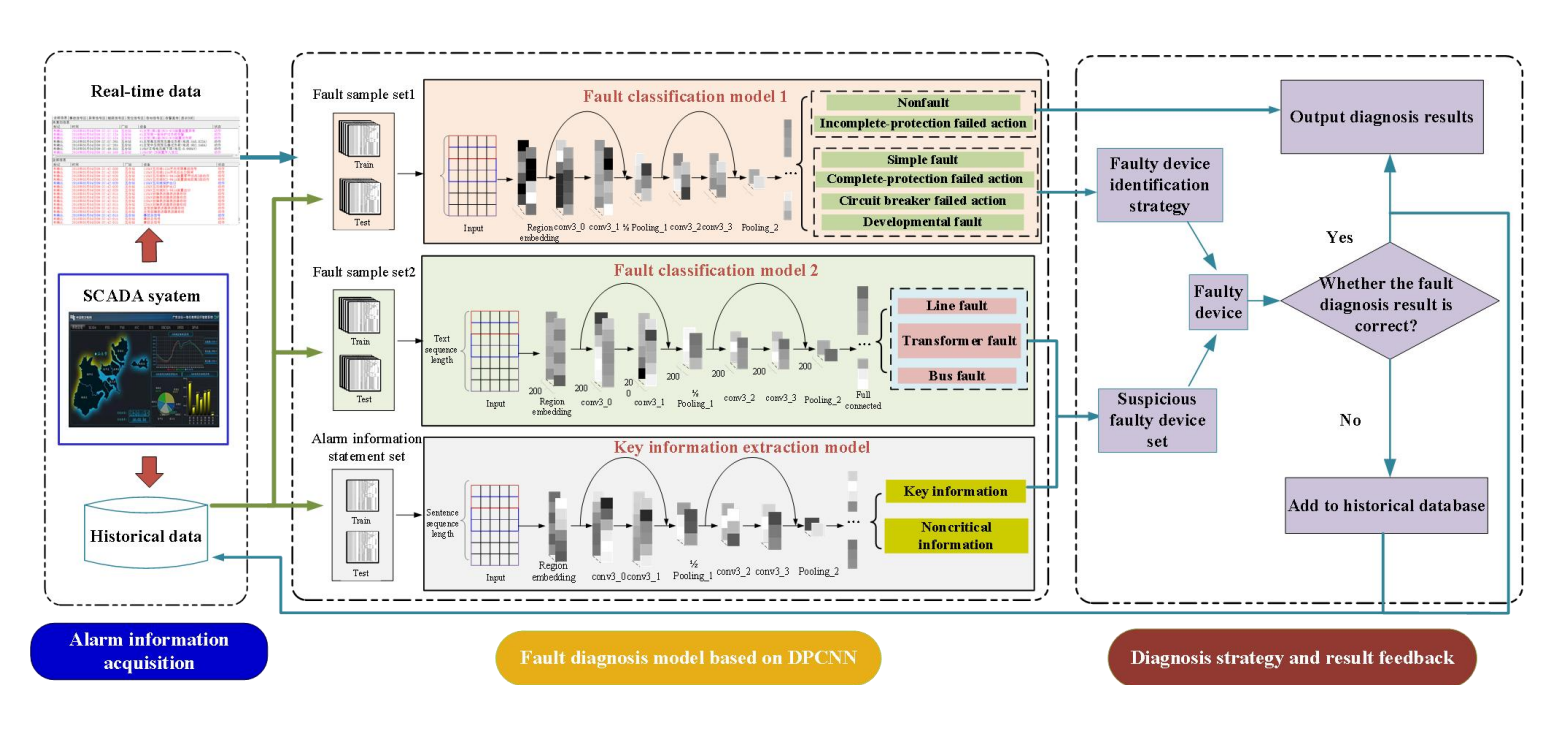
Existing power grid fault diagnosis methods rely on manual experience to design diagnosis models, lack the ability to extract fault knowledge, and are difficult to adapt to complex and changeable engineering sites. In this context, this paper proposes a power grid fault diagnosis method based on a deep pyramid convolutional neural network for the alarm information set.
This approach uses the deep feature extraction ability of the network to extract fault feature knowledge from alarm information texts and achieve end-to-end fault classification and fault device identification. First, a deep pyramid convolutional neural network model for extracting the overall characteristics of fault events is constructed to identify fault types. Second, a deep pyramidal convolutional neural network model for alarm information text is constructed, the text description characteristics associated with alarm information text are extracted, the key information corresponding to faults in the alarm information set is identified, and suspicious faulty devices are selected.
Then, a fault device identification strategy that integrates fault-type and time sequence priorities is proposed to identify faulty devices. Finally, the actual fault cases and the fault cases generated by simulation are studied, and the results verify the effectiveness and practicability of the method presented in this paper.