MMM
YYYY
Plasma and nanoparticle shielding during pulsed laser ablation in liquids cause ablation efficiency decrease
液体中脉冲激光烧蚀过程中的等离子体和纳米粒子屏蔽会导致烧蚀效率降低
液体中でのパルスレーザーアブレーション中のプラズマおよびナノ粒子のシールドは、アブレーション効率の低下を引き起こします
액체에서 펄스 레이저 절제 중 플라즈마 및 나노 입자 차폐로 인해 절제 효율 감소
El blindaje de plasma y nanopartículas durante la ablación con láser pulsado en líquidos provoca una disminución de la eficiencia de la ablación
Le blindage au plasma et aux nanoparticules pendant l'ablation laser pulsée dans les liquides entraîne une diminution de l'efficacité de l'ablation
Защита плазмы и наночастиц при импульсной лазерной абляции в жидкостях приводит к снижению эффективности абляции

Sarah Dittrich, Stephan Barcikowski, Bilal Gökce
Technical Chemistry I and Center of Nanointegration Duisburg Essen (CENIDE), University of Duisburg-Essen, Universitaetsstr. 7, 45141 Essen, Germany
Opto-Electronic Advances, 27 January 2021
Abstract

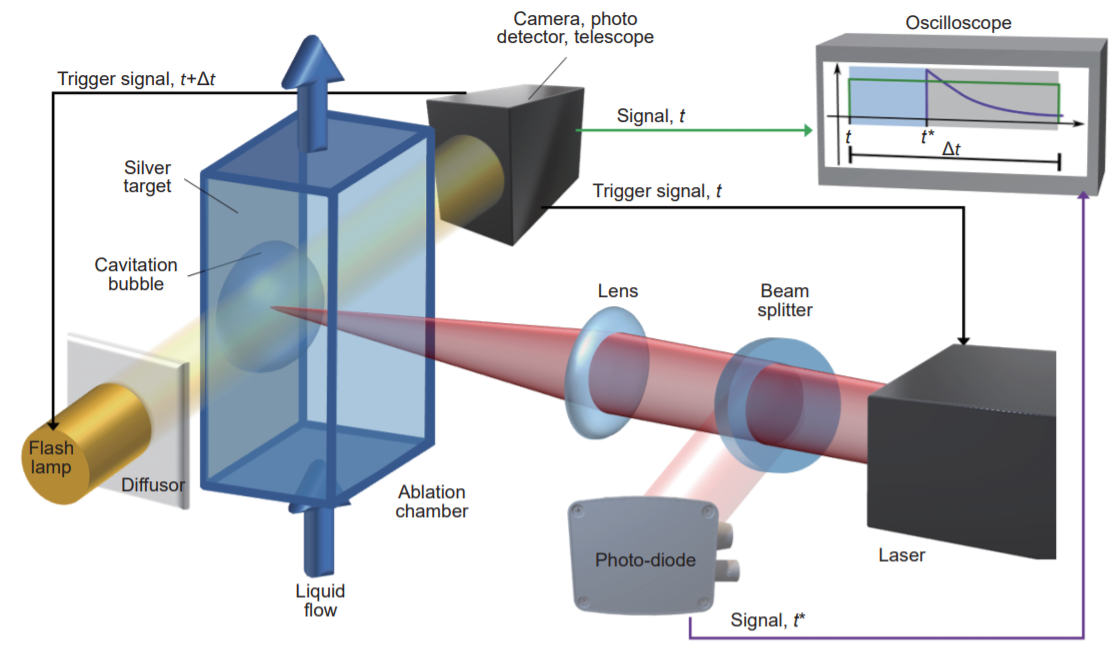
Understanding shielding cross-effects is a prerequisite for maximal power-specific nanosecond laser ablation in liquids (LAL). However, discrimination between cavitation bubble (CB), nanoparticle (NP), and shielding, e.g., by the plasma or a transient vapor layer, is challenging. Therefore, CB imaging by shadowgraphy is performed to better understand the plasma and laser beam-NP interaction during LAL.

By comparing the fluence-dependent CB volume for ablations performed with 1 ns pulses with reports from the literature, we find larger energy-specific CB volumes for 7 ns-ablation. The increased CB for laser ablation with higher ns pulse durations could be a first explanation of the efficiency decrease reported for these laser systems having higher pulse durations. Consequently, 1 ns-LAL shows superior ablation efficiency.

Moreover, a CB cascade occurs when the focal plane is shifted into the liquid. This effect is enhanced when NPs are present in the fluid. Even minute amounts of NPs trapped in a stationary layer decrease the laser energy significantly, even under liquid flow. However, this local concentration in the sticking film has so far not been considered. It presents an essential obstacle in high-yield LAL, shielding already the second laser pulse that arrives and presenting a source of satellite bubbles. Hence, measures to lower the NP concentration on the target must be investigated in the future.
Opto-Electronic Advances_1
Opto-Electronic Advances_2
Opto-Electronic Advances_3
Opto-Electronic Advances_4
Reviews and Discussions
https://www.hotpaper.io/index.html
Phonon-assisted absorption photoconductive switch
Photonic spiking reinforcement learning for intelligent routing
Femtosecond laser rapid customization of high-performance anti-reflection windows
Ppt-level volatile organic compounds detection via microsecond-pulse-enhanced mid-infrared photoacoustic
Terahertz imaging technology: progress and applications
Interpretable low-dose CT enhancement via multi-Gaussian cluster variance reduction
Polygonal generalized perfect spatiotemporal optical vortices
A 4096-element 3D-integrated Si-SiN optical phased array for high-power coherent LiDAR
Multi-scale attention residual deep convolutional dealiasing network-assisted unambiguous ultra-long baseline high-precision microwave photonic angle of arrival estimation
Dual quasi-BIC resonances synergized laser cooling in halide perovskite metasurface
High-speed and large-capacity visible light communication for 6G: advances and perspectives
Multi-dimensional photodetection: from material intrinsic properties and metasurface engineering to silicon photonic integration


Previous Article                                Next Article
About
|
Contact
|
Copyright © Hot Paper