Ppt-level volatile organic compounds detection via microsecond-pulse-enhanced mid-infrared photoacoustic
通过微秒脉冲增强的中红外光声技术实现PPT级挥发性有机化合物检测
マイクロ秒パルス増強型中赤外光音響法によるPPTレベル揮発性有機化合物検出
미세초 펄스 강화형 중적외선 광음향을 통한 PPT 수준의 휘발성 유기 화합물 검출
Detección de compuestos orgánicos volátiles a nivel de Ppt mediante fotoacústica infrarroja media potenciada por pulso de microsegundos
Détection de composés organiques volatils au niveau de Ppt via photoacoustique infrarouge moyen amplifiée par impulsion de microseconde
Выявление летучих органических соединений на уровне Ppt с помощью микросекундной импульсной усиленной средней инфракрасной фотоакустики
Senyu Wang 王森宇 ¹ ³, Liang Zhao 赵亮 ¹, Hongyu Luo 罗鸿禹 ¹, Xiangyu Zhao 赵翔宇 ¹, Jianfeng Li 李剑峰 ¹ ², Wei Wang 王伟 ¹, Hao Lei 雷浩 ¹, Mingrui Jiang 姜明瑞 ¹, Jinlong Wan 万金龙 ¹, Binxing Zhao 赵斌兴 ¹, Bincheng Li 李斌成 ¹, Yong Liu 刘永 ¹
¹ School of Optoelectronic Science and Engineering, University of Electronic Science and Technology of China, Chengdu 610054, China
中国 成都 电子科技大学光电科学与工程学院
² Tianfu Jiangxi Laboratory, Chengdu 641419, China
中国 成都 天府绛溪实验室
³ Institute for Photon Science and Technology, School of Science, The University of Tokyo, Tokyo 113-0033, Japan
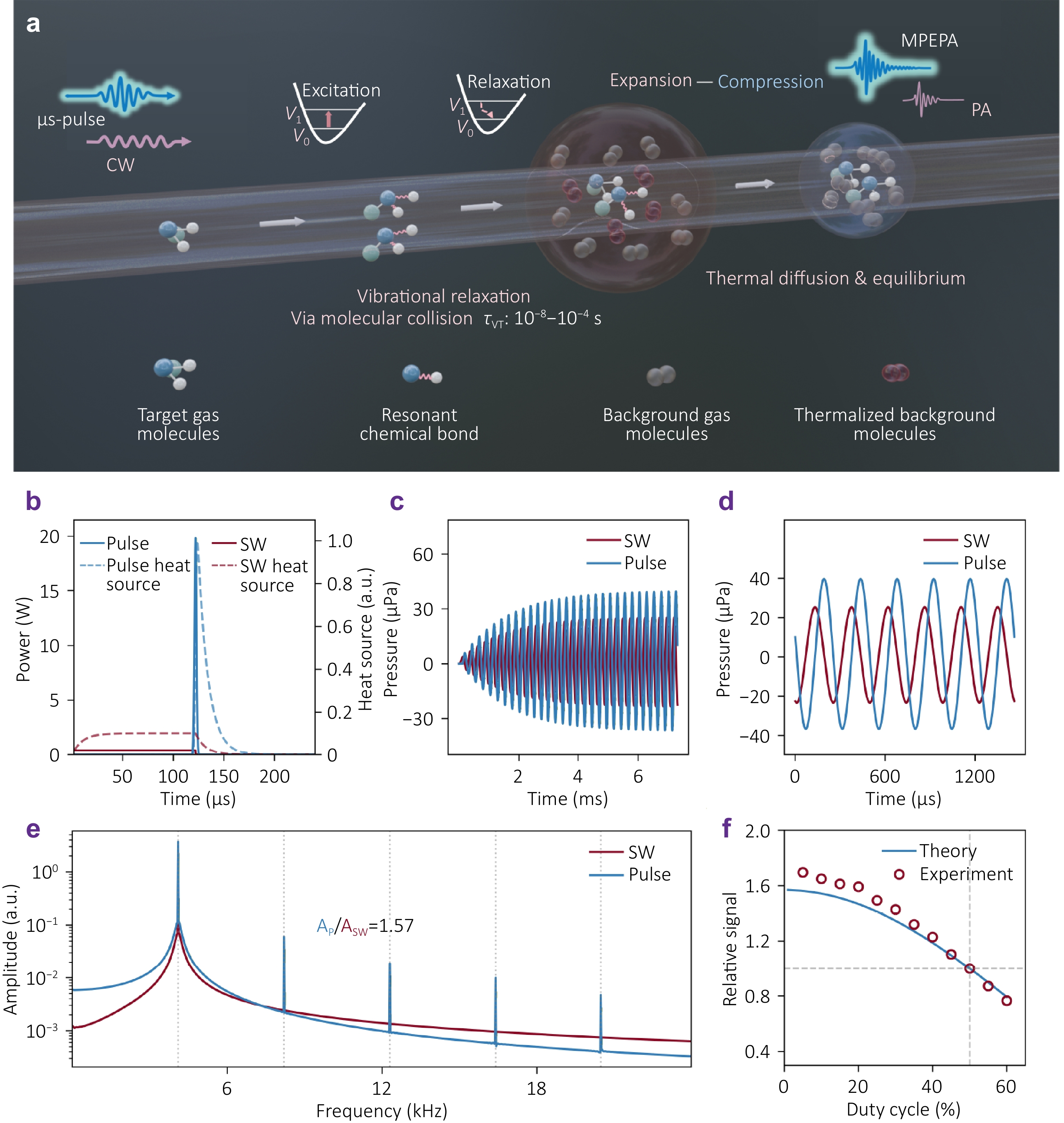
Ultrasensitive detection of volatile organic compounds (VOCs) is pivotal for early disease diagnosis and industrial safety, yet existing photoacoustic spectroscopy (PAS) systems struggle to breach the sub-ppb barrier required for practical applications. Here, we overcome this limitation by demonstrating a PAS architecture driven by a gain-switched Er3+/Dy3+ co-doped mid-infrared fiber laser, achieving an unprecedented detection limit of 416 ppt for propane, which is an order-of-magnitude improvement over state-of-the-art systems.
This performance arises from a direct pump-modulation strategy that generates high-energy microsecond pulses to significantly enhance photoacoustic excitation without power loss. Crucially, the laser's broad tunability (3.2–3.55 μm) covers the fundamental C-H stretching band, enabling not only high-resolution spectral reconstruction but also the versatile detection of multiple disease markers and industrial hazards, including isoprene (cardiovascular biomarker), 1,2-dimethoxyethane (battery failure indicator), and propanal (food safety marker).
By delivering clinical-grade sensitivity in a compact, robust fiber-based format, this work establishes a transformative pathway toward deployable, high-performance gas sensing solutions.