A compression-decompression framework for universal acceleration of photonic neuromorphic computing
用于光子神经形态计算通用加速的压缩-解压缩框架
光子神経形態計算用の汎用加速のための圧縮−解凍フレームワーク
광자 신경형성 컴퓨팅의 보편적인 가속화를 위한 압축-해압 프레임워크
Un marco de compresión-descompresión para la aceleración universal de la computación neuromórfica fotónica
Un cadre de compression-décompression pour l'accélération universelle du calcul neuromorphique photonique
Сжатие-декомпрессия для универсального ускорения фотонных нейроморфных вычислений
Changdi Zhou 周长笛 ¹ ², Deyu Cai 蔡德宇 ¹ ², Yu Huang 黄于 ¹ ², Yigong Yang 杨一功 ¹ ², Pei Zhou 周沛 ¹ ², Kuenyao Lau 刘坤耀 ¹ ², Nianqiang Li 李念强 ¹ ²
¹ School of Optoelectronic Science and Engineering & Collaborative Innovation Center of Suzhou Nano Science and Technology, Soochow University, Suzhou 215006, China
中国 苏州 苏州大学光电科学与工程学院 苏州纳米科技协同创新中心
² Key Laboratory of Advanced Optical Manufacturing Technologies of Jiangsu Province & Key Laboratory of Modern Optical Technologies of the Ministry of Education, Soochow University, Suzhou 215006, China
中国 苏州 苏州大学 江苏省先进光学制造技术重点实验室 教育部现代光学技术重点实验室
Photonic neuromorphic computing provides an effective route to overcoming the fundamental bottlenecks of the von Neumann architecture. However, the realization of complex optical nonlinearities by time-division multiplexing in traditional photonic neuromorphic computing limits both information-processing speed and scalability of these systems.
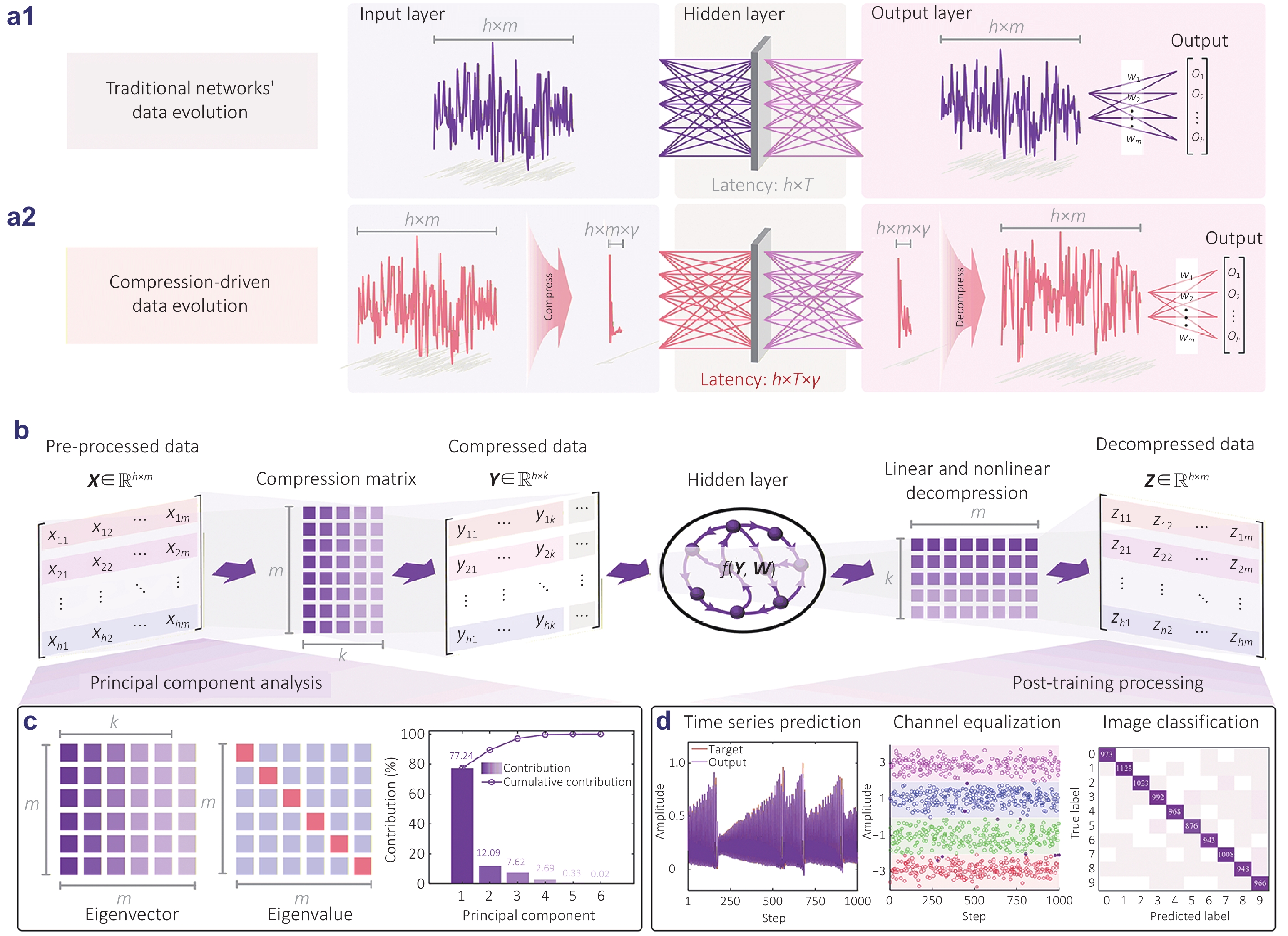
Here, we break this bottleneck by introducing an accuracy-compensated compression strategy that co-optimizes latency and speed without sacrificing computational fidelity. Our core innovation is an eigenvector-driven compression-decompression framework that projects input data into a task-relevant subspace, drastically reducing the data volume processed by the hidden layer. This paradigm shift enables photonic neuromorphic computing to achieve image recognition and time-series prediction tasks in the optical domain at speeds of 100 million images and 600 million data points per second, respectively.
We experimentally validate our approach across both a continuous-wave system based on off-the-shelf lasers and a spiking system composed of a specifically fabricated photonic neuro-synaptic chip, demonstrating that the compression-decompression framework effectively recovers the accuracy to the level of uncompressed networks—e.g., achieving >95% on MNIST and >84% on Fashion-MNIST—while slashing latency and hardware resource demands by an order of magnitude.
This strategy establishes a scalable pathway towards high-throughput, low-power neuromorphic chips, bridging a critical gap between algorithmic efficiency and physical computing paradigms.