Active retinal projection augmented reality display via pixel-to-pixel collimation
通过像素间准直实现主动视网膜投影增强现实显示
画素間コリメートによるアクティブ網膜投影による拡張現実表示の実現
픽셀-to-픽셀 협정을 통해 활성 망막 투영 증강 현실 디스플레이
Visualización de realidad aumentada de proyección retinal activa mediante colimación de píxel a píxel
Projection rétinienne active affichage de réalité augmentée via la collimation pixel-à-pixel
Дисплей дополненной реальности с активной сетчаточной проекцией через коллимацию пикселей на пиксель
Xiang Zhang 张翔 ¹, Yuanlong Huang 黄元龙 ¹, Weiyao Fan 范巍耀 ¹, Enguo Chen 陈恩果 ², Jiajun Luo 罗家俊 ¹
¹ Wuhan National Laboratory for Optoelectronics (WNLO) and School of Optical and Electronic Information, Huazhong University of Science and Technology (HUST), 1037 Luoyu Road, Wuhan 430074, China
中国 武汉 华中科技大学光学与电子信息学院 武汉光电国家实验室
² National & Local United Engineering Laboratory of Flat Panel Display Technology and College of Physics and Information Engineering, Fuzhou University (FZU), Fuzhou 350108, China
中国 福州 福州大学物理与信息工程学院平板显示技术国家地方联合工程实验室
As the next-generation human–computer interface, augmented reality display technology has been gradually popular, depending on advances in system architectures. However, existing waveguide and passive retinal projection display solutions are unable to combine their respective advantages to address increasingly demanding performance requirements.
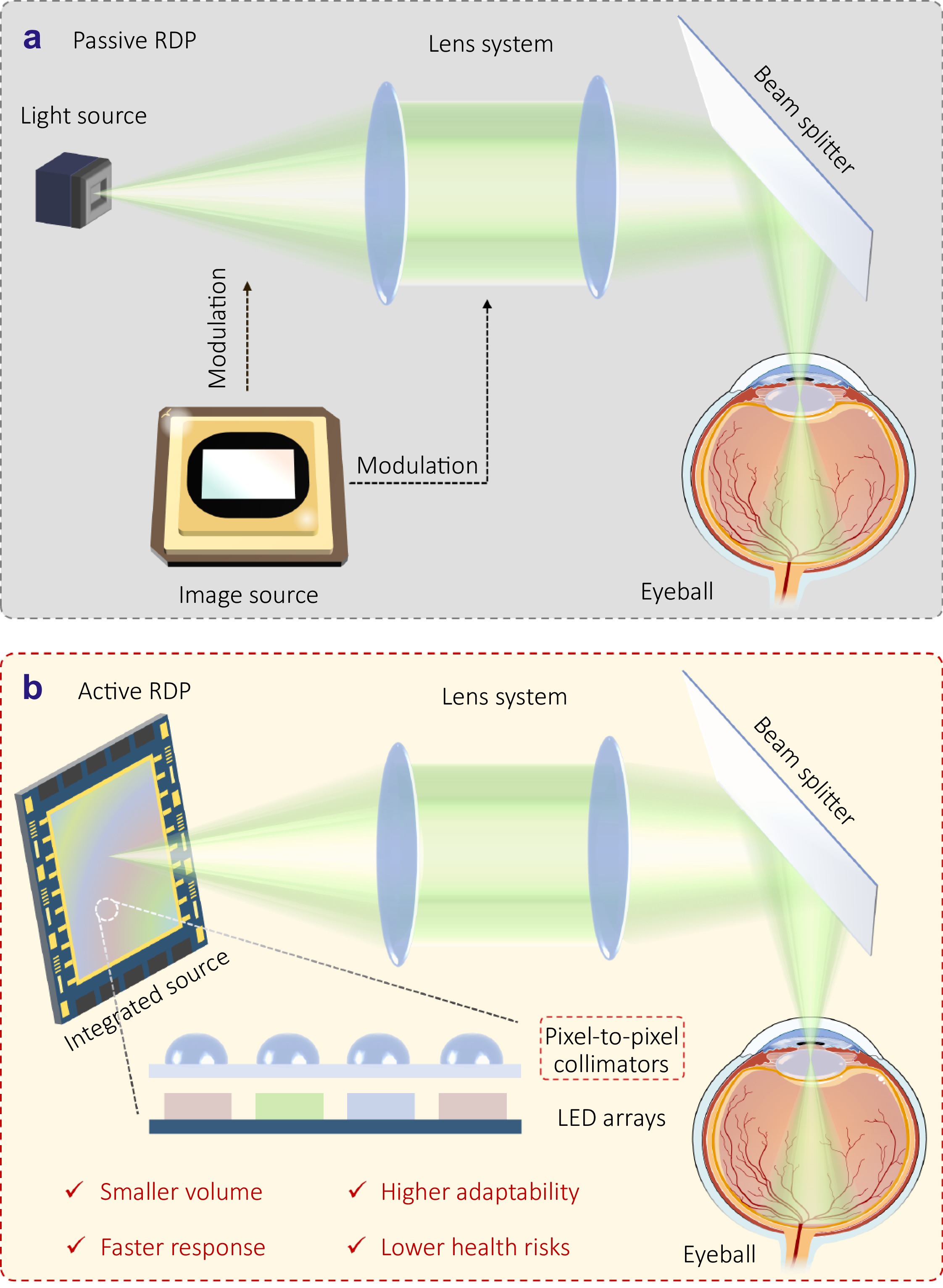
Herein, we propose an active retinal projection display (A-RPD) concept based on collimated active-matrix microdisplay panels. By deriving and validating the collimation-dependent depth of focus, the optimization direction of this architecture is emphasized. Through the direct integration of pixel-to-pixel collimators on the microdisplay panels, an A-RPD prototype featuring a balanced design and performance has been successfully constructed.
It enables clear retinal imaging from 40 cm to 160 cm, which significantly surpasses that of the uncollimated microdisplay. The proposed active retinal projection architecture retains the advantages of retinal projection while simplifying the architecture. This work highlights its importance and superiority and provides foundations for its further expansion in practical applications.