Statistical SERS spectroscopy based on concentration-encoded intensity distributions for deep-learning-assisted quantitation
基于浓度编码强度分布的统计SERS光谱用于深度学习辅助定量
濃度符号化強度分布に基づく統計的SERSスペクトルを用いた深さ学習支援定量
깊은 학습 지원 정량을 위한 농도 인코딩 된 강도 분포를 기반으로 하는 통계 SERS 분광학
Espectroscopia estadística SERS basada en distribuciones de intensidad codificadas por concentración para cuantificación asistida por aprendizaje profundo
Spectroscopie statistique SERS basée sur des distributions d'intensité codées par concentration pour la quantification assistée par l'apprentissage profond
Статистическая спектроскопия SERS на основе распределений интенсивности, кодированных концентрацией, для количественного измерения при помощи глубокого обучения
Meng Zhang ¹, Hui Ding ², Luyuan Xie ³, Chaowei Sun ⁴, Shiyu Zhang ², Yue Wei ¹, Di Zheng ¹, Ferruccio Pisanello ⁵, Longkun Yang ¹, Hongxing Xu ⁴, Zhipeng Li ¹
¹ Beijing Key Laboratory for Nano-Photonics and Nano-Structure (NPNS), Department of Physics, Capital Normal University, Beijing 100048, China
中国 北京 首都师范大学物理系北京市纳米光电子学重点实验室
² Beijing Key Laboratory of Electronic System Reliability Technology, College of Information Engineering, Capital Normal University, Beijing 100048, China
中国 北京 首都师范大学信息工程学院电子系统可靠性技术北京重点实验室
³ School of Software and Microelectronics, Peking University, Beijing 100091, China
中国 北京 北京大学软件与微电子学院
⁴ Henan Academy of Sciences, Zhengzhou 450046, China
中国 郑州 河南省科学院
⁵ Istituto Italiano di Tecnologia, Center for Biomolecular Nanotechnologies, Arnesano, Lecce 73010, Italy
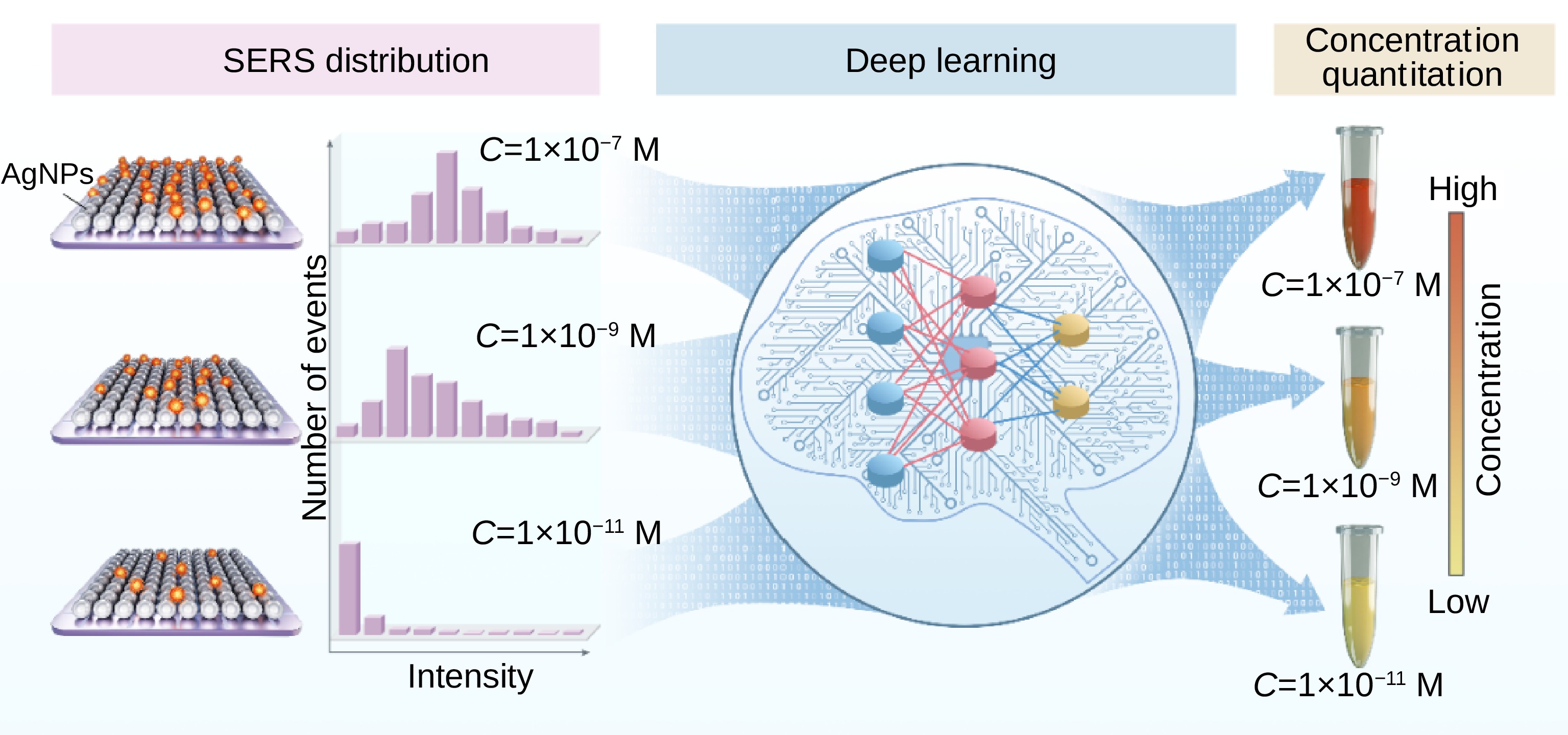
Reliable quantitative SERS analysis is limited by strong intensity fluctuations arising from stochastic molecule-substrate-light interactions. Here, we reveal that SERS intensity distributions carry concentration-dependent statistical information, exhibiting a characteristic evolution from an asymmetric long-tailed profile at low concentration to a nearly symmetric Gaussian-like pattern at high concentration.
This concentration-dependent evolution originates from stochastic molecular adsorption at plasmonic “hot spots” and can be reproduced by Poisson-statistics-based Monte Carlo simulations. On this basis, we propose a statistical SERS strategy for concentration-level quantitation, in which concentration-encoded intensity distribution patterns are identified using a ResNet4 deep learning model. Accurate concentration identification of R6G is achieved, and the generality of this method is further demonstrated by the analysis of methamphetamine in methanol, thiram in bean sprout extract, and rosiglitazone maleate in serum.
These results transform intrinsic SERS intensity fluctuations from a limitation of conventional intensity-based quantitation into useful statistical fingerprints, which certainly deepens our understanding about the stochastic nature of SERS and provides a new route toward reliable SERS quantitation for chemical and biological analysis.