飞秒激光雕刻三维光学手性
フェムト秒レーザー彫刻3次元光学キラリティ
Femtosecond 레이저는 3D 광학 chirality를 기록했습니다.
Quiralidad óptica 3D inscrita con láser de femtosegundos
Chiralité optique 3D laser femtoseconde inscrit
Фемтосекундный лазер с 3D оптической хиральностью
Qingchuan Ye ¹, Han Zhu ¹ ⁴, Bo Wu ¹, Lingrui Chu ¹, Bin Zhang ¹, Shengqiang Zhou ³, Saulius Juodkazis ², Feng Chen ¹
¹ School of Physics, State Key Laboratory of Crystal Materials, Shandong University, Jinan 250100, China
中国 济南 山东大学物理学院晶体材料全国重点实验室
² Optical Sciences Centre, Faculty of Science, Engineering and Technology, Swinburne University of Technology, Hawthorn, VIC 3122, Australia
³ Institute of Ion Beam Physics and Materials Research, Helmholtz-Zentrum Dresden-Rossendorf, Dresden 01328, Germany
⁴ Thin Film Optics R&D Center, Department of High-power Laser Optics Technology and Engineering, Shanghai Institute of Optics and Fine Mechanics, Chinese Academy of Sciences, Shanghai 201800, China
中国 上海 中国科学院上海光学精密机械研究所高功率激光元件技术与工程部薄膜光学研发中心
Chiral materials, owing to their unique capability to differentiate between spin states of light for their generation as well as detection and due to spin-orbit conversion of angular momentum, have garnered interest in photonic integrated circuits, optical sensing, and quantum optics. Yet, realizing large-scale, parameter-tunable, and cost-effective chiral nanostructures in inorganic crystals remains challenging. Metallic nanoparticles, widely used in various optical applications, offer a promising pathway.
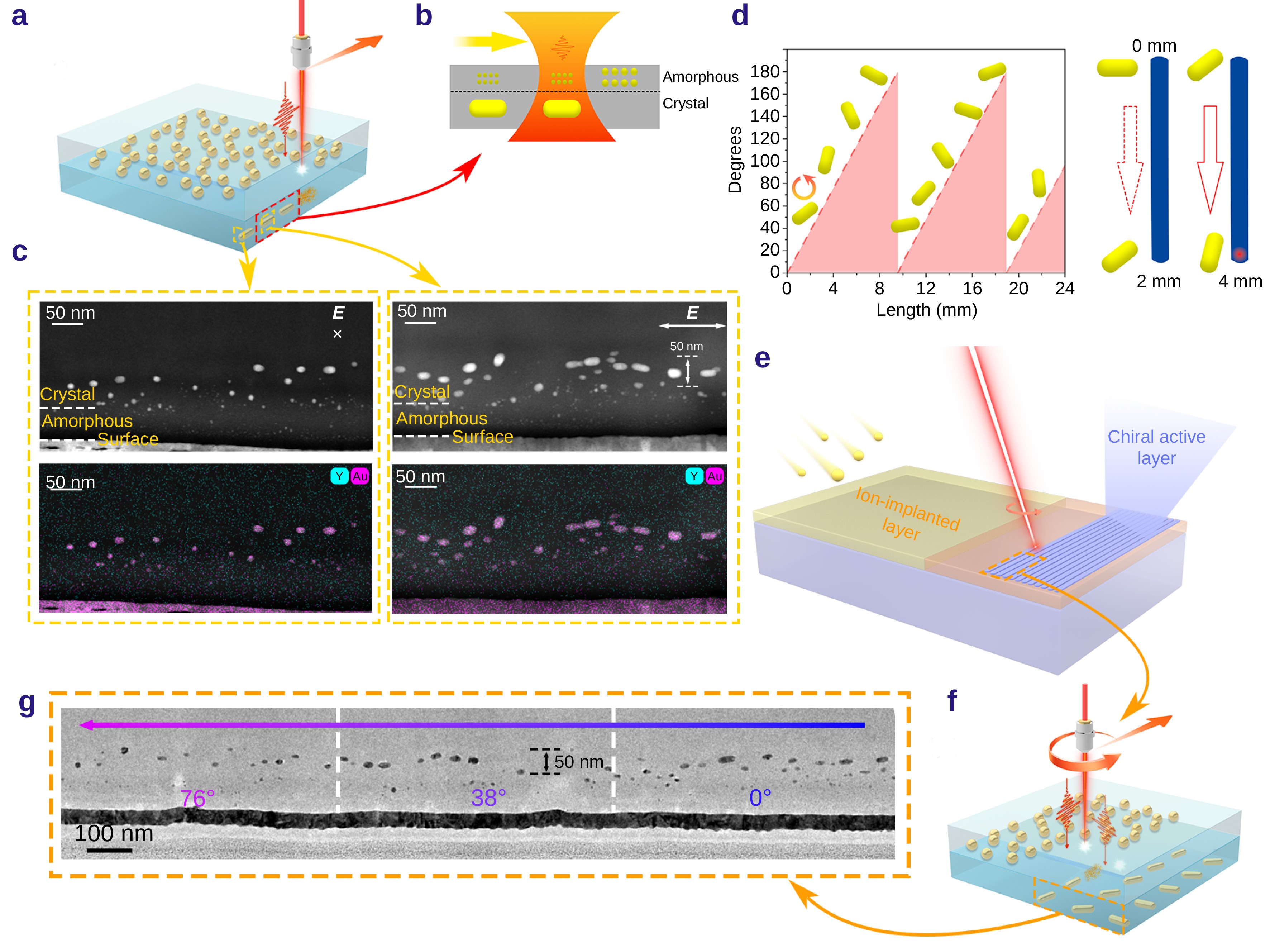
Their subwavelength field enhancement, arising from localized surface plasmon resonance, magnifies the absorption differences introduced by chiral configurations and enables rapid, large-area, precisely defined, and controllable in-situ system evolution under external electromagnetic excitation. Here, we present a novel strategy to generate optical chirality solely by manipulating encapsulated nanoparticles using femtosecond laser pulses and forming rotationally arranged nanoparticles within the yttrium aluminum garnet (YAG) lattice.
Laser-induced symmetry breaking endows nanostructures inscribed in the 3D volume of the crystal with chiral optical responses that can be tailored from the visible to the near-infrared spectral range and are reproducible along two mutually orthogonal directions. The parameterizable and customizable chiral crystals enabled by this approach hold strong promise for diverse photonics fields including quantum photonics, paving the way for brand new applications of direct write laser nanolithography.