Laser-induced biocompatible molybdenum dioxide for versatile wearable bioelectronics
用于多功能可穿戴生物电子学的激光诱导生物相容性二氧化钼
多機能ウェアラブルバイオエレクトロニクス用のレーザ誘起生体適合性二酸化モリブデン
다양한 착용 가능한 생물 전자 제품을 위한 레이저 유도된 생물 호환성 이산화мол리브덴
Dióxido de molibdeno biocompatible inducido por láser para bioelectrónica portátil versátil
Dioxyde de molybdène biocompatible induit par laser pour la bioélectronique portable polyvalente
Лазерно-индуцированный биосовместимый диоксид молибдена для универсальной носимой биоэлектроники
Jiayan Li ¹, Zimo Cai ¹, Yuyu Hou ¹, Huayong Yang ¹, Inkyu Park ², Geng Yang ¹, Kaichen Xu ¹
¹ State Key Laboratory of Fluid Power & Mechatronic Systems, School of Mechanical Engineering, Zhejiang University, Hangzhou 310058, China
中国 杭州 浙江大学机械工程学院流体动力基础件与机电系统全国重点实验室
² Department of Mechanical Engineering, Korea Advanced Institute of Science and Technology, Daejeon 34141, Republic of Korea
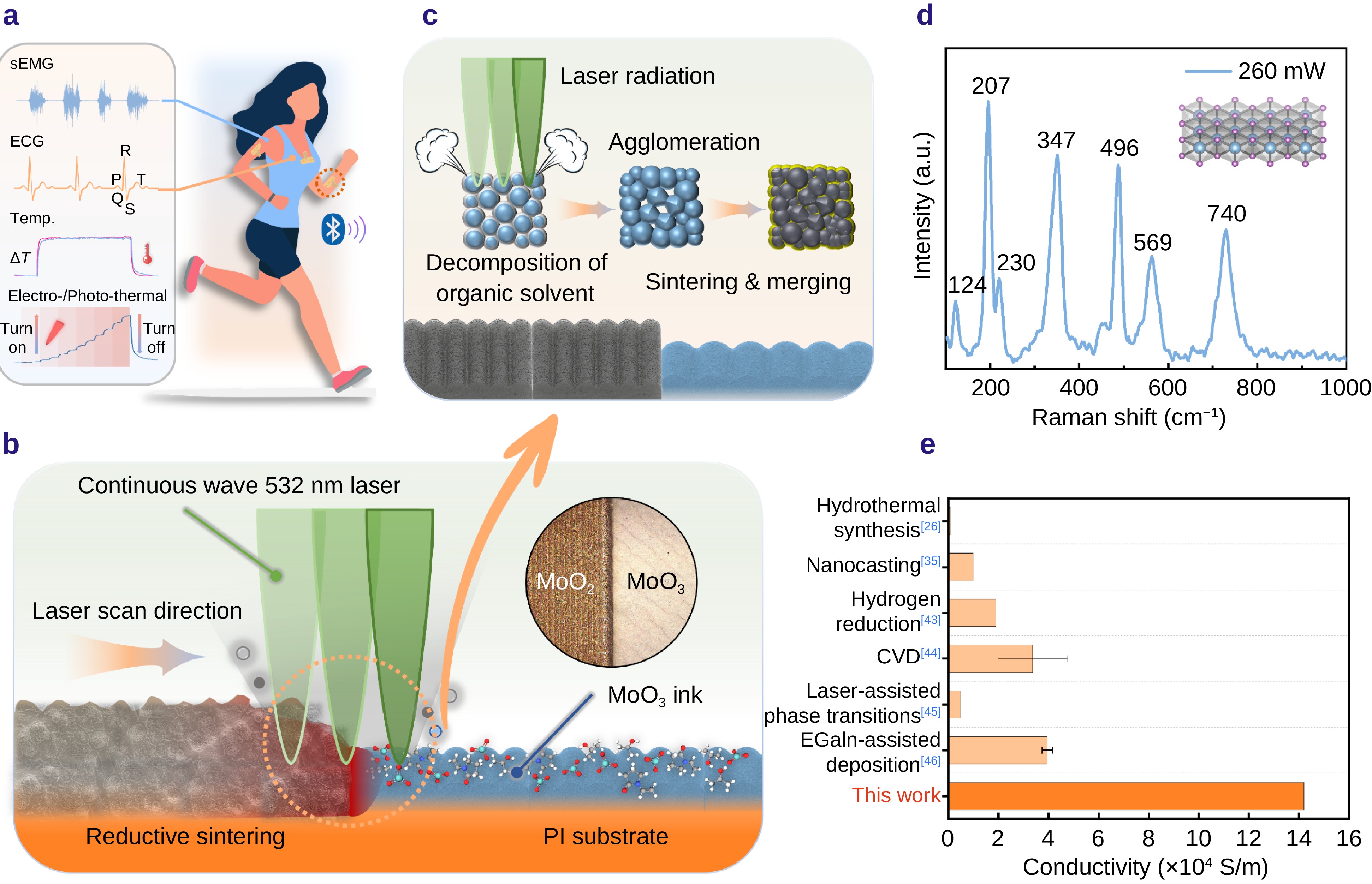
Molybdenum dioxide (MoO₂), a transition metal oxide known for its exceptional electrical conductivity, photothermal sensitivity, and biocompatibility, is traditionally synthesized via hydrothermal methods that suffer from long reaction cycles, harsh environments, and limited patternability. Herein, an ambient-condition, in-situ laser-induced photothermal reduction of MoO₃ to MoO₂ is realized by exploiting a tailored precursor ink and localized laser irradiation.
The intense photothermal heat facilitates the reduction of MoO₃ by the reductant, synchronously driving the structural phase transition and compact sintering. The resulting MoO₂ exhibits outstanding electrical conductivity (up to 1.42 × 10⁵ S/m) while maintaining competitive biocompatibility. As typical demonstrations, the laser-induced MoO₂ is seamlessly integrated into wearable bioelectronics for multifunctional applications, ranging from electro-/photo-thermal therapy to wireless electrophysiological signal monitoring (e.g., surface electromyography and electrocardiogram).
This work affords a scalable, energy-efficient route for manufacturing high-performance transition metal oxide-based flexible electronics.