Imprinted high-Q polymer micro-ring resonator array for high-resolution photoacoustic tomography
用于高分辨率光声层析成像的压印式高Q值聚合物微环谐振器阵列
高解像度光音響断層撮影用インプリント高Qポリマーマイクロリング共振器アレイ
고해상도 광음향 단층촬영을 위한 인쇄된 고-Q 폴리머 마이크로 링 공진기 어레이
Matriz de resonadores de microanillos de polímero de alta Q grabados para tomografía fotoacústica de alta resolución
Réseau de résonateurs micro-annulaires polymères à haute Q imprimé pour la tomographie photoacoustique haute résolution
Массив импринтированных микрополосковых резонаторов на основе полимерных колец с высоким Q-фактором для высокочастотной фотоакустической томографии
Hyeonwoo Kim ¹, Wei-Kuan Lin 林玮冠 ¹, Linyu Ni ², Mohammad Ali ¹, Xueding Wang 王学鼎 ² ³, Guan Xu ² ⁴, L. Jay Guo 郭凌杰 ¹
¹ Department of Electrical Engineering and Computer Sciences, University of Michigan, Ann Arbor 48109, USA
² Department of Biomedical Engineering, University of Michigan, Ann Arbor 48109, USA
³ Department of Radiology, University of Michigan, Ann Arbor 48109, USA
⁴ Department of Ophthalmology and Visual Sciences, University of Michigan, Ann Arbor 48105, USA
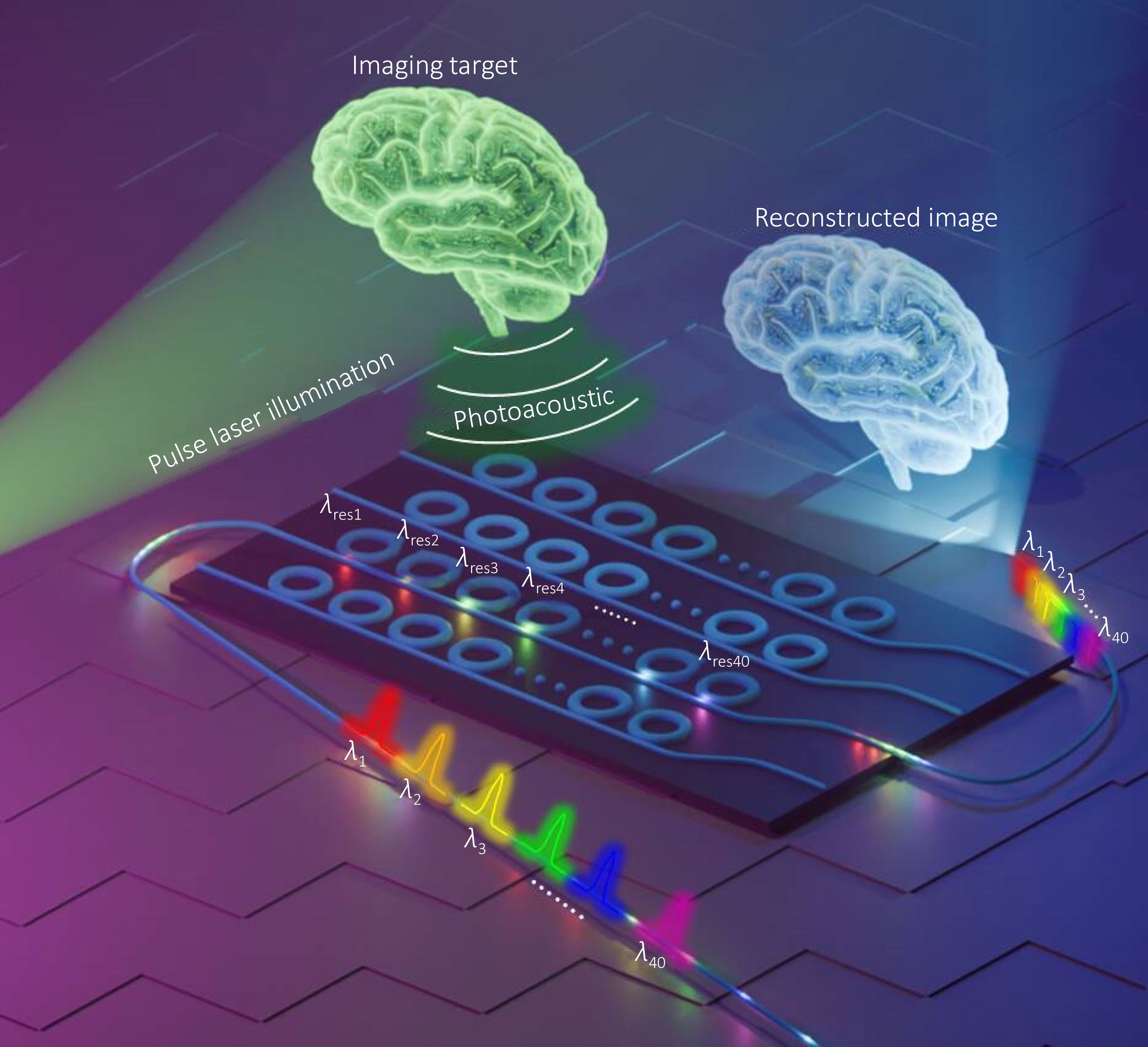
We present the first demonstration of a polymer-based micro-ring resonator array with over 40 elements fabricated using nanoimprint lithography (NIL), and its application for photoacoustic tomography imaging. By precisely varying the radius of each micro-ring at the nanometer scale and maintaining its high-quality factor, we achieved distinguishable resonances within a free spectral range of only 2.19 nm.
The micro-ring array was used to perform photoacoustic tomography (PAT), achieving lateral and axial resolutions of 40 µm and 38 µm, respectively, and an ultrasound response bandwidth of 173.5 MHz, and a noise equivalent pressure (NEP) of 13.5 Pa. PAT images of ex vivo mouse prostates were acquired by the micro-ring array, showing a high correlation with biological tissue structures and regions of blood vessels. Further spectral analysis of the PAT images can differentiate the prostate cancers from the normal prostates.
This work highlights the significant advantages of using NIL-fabricated micro-ring resonator arrays made from polymer materials, demonstrating their potential for advanced applications in biomedical imaging as well as optical communications and integrated photonic systems.