Rayleigh-driven ethanol cluster tracking based on non-contact deep optical molecular diagnosis
基于非接触式深度光学分子诊断的瑞利驱动乙醇团簇追踪
非接触深光学分子診断に基づくレイリー駆動エタノールクラスタ追跡
레이leigh 기반 비접촉식 심층 광학 분자 진단을 통한 에탄올 클러스터 추적
Seguimiento de clusters de etanol impulsado por Rayleigh basado en diagnóstico molecular óptico profundo sin contacto
Suivi des agrégats d'éthanol piloté par Rayleigh basé sur le diagnostic moléculaire optique profond sans contact
Отслеживание этаноловых кластеров, управляемое Рэлеем, на основе бесконтактной глубокой оптической молекулярной диагностики
Geon Mo Kim ¹, Yun Ji Hwang ¹, Chengyi Li ¹, Teajong Hwang ¹, In-Sung Hwang ², James Hone ³, Seong Chan Jun ¹
¹ School of Mechanical Engineering, Yonsei University, 50, Yonsei-ro, Seodaemun-gu, Seoul 03722, Republic of Korea
² Sentech GMI Co. Ltd, Seoul 07548, Republic of Korea
³ Department of Mechanical Engineering, Columbia University, 500 West 120th Street, Mudd 220, New York 10027, USA
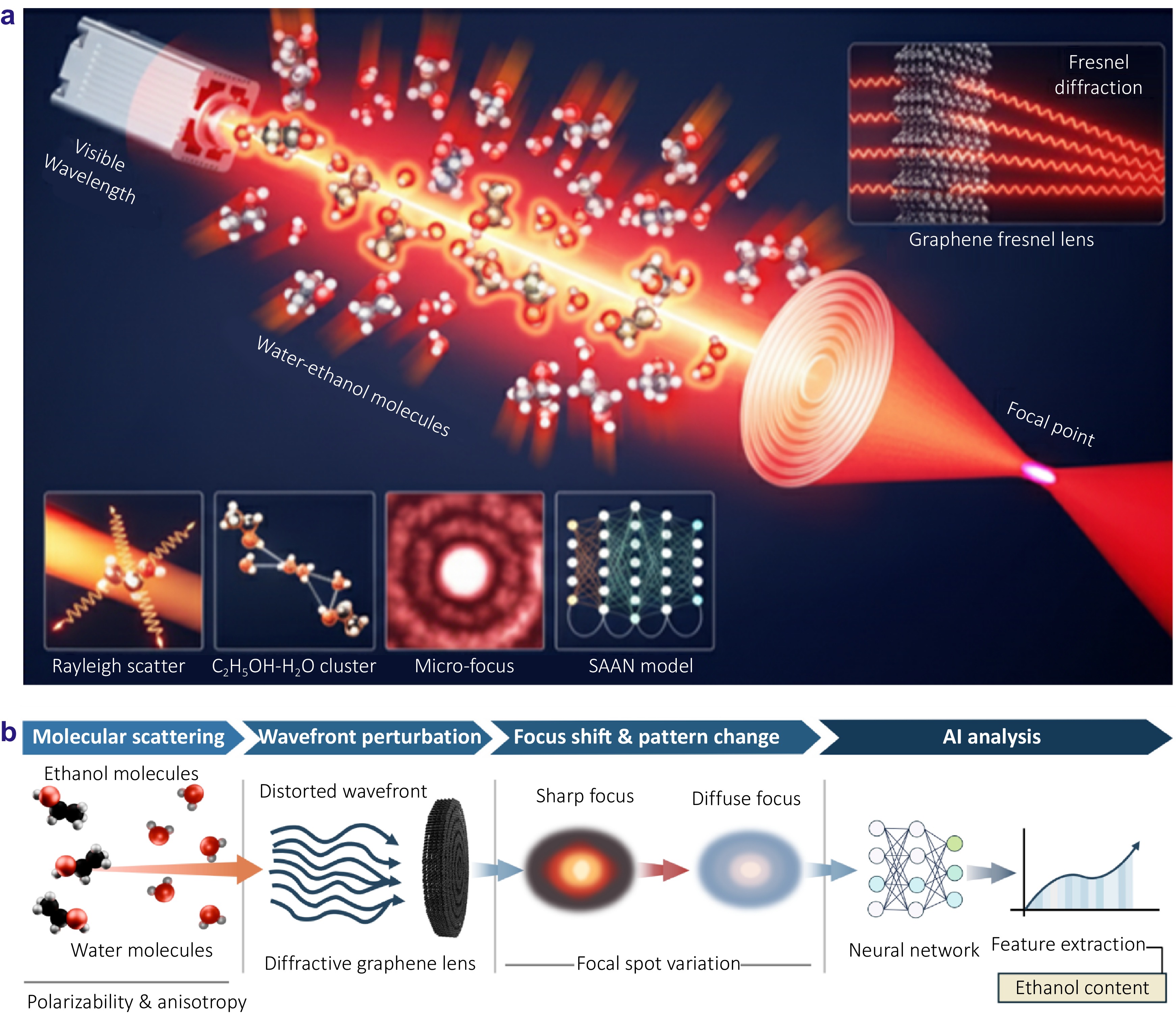
Investigating the composition ratio of ethanol–water molecular clusters in air, which are responsible for anisotropic behavior, is a significant challenge, primarily owing to the difficulty of detecting Rayleigh scattering, an inherently weak signal highly susceptible to external interference. This study overcame these limitations by integrating laser diffraction focusing with artificial neural networks.
We demonstrate a fully non-contact sensing system that circumvents the direct measurement of difficult-to-distinguish Rayleigh scattering signals. Our approach infers ethanol content by utilizing a self-fabricated multi-layered graphene Fresnel lens. An analysis of gaseous ethanol content in the 0.01%–0.1% range revealed that while a wavelength of 405 nm exhibited high sensitivity with up to a 7% intensity change corresponding to ethanol content, a wavelength of 638 nm provided superior stability for deep-learning analysis as its intensity parameter remained fixed. Ultimately, by combining the 638 nm laser with our self-developed self-aware assembly network model, we successfully inferred ethanol content with an R2 of 0.884, even under varied power conditions.
This study creates a new path for recognizing weak Rayleigh scattering signals that were previously difficult to measure and may facilitate the development of rapid and durable sensing systems, such as for the non-invasive diagnosis of gas molecules.