Tunable compound eyes with coaxial lens-on-lens ommatidia for cooperative bi-focal imaging
具有同轴透镜-透镜式小眼结构的可调复眼,用于协同双焦成像
共軸レンズ重ね型オマトイダを持つ可変式複眼:協調バイフォーカルイメージングのための複眼
조정 가능한 복합 눈, 동축 렌즈-온-렌즈 옴마티디아를 위한 협력형 이초점 이미징
Ojos compuestos ajustables con ommatidios coaxiales de lente sobre lente para imágenes bifocales cooperativas
Œil composé réglable avec ommatidies coaxiales à lentilles empilées pour l'imagerie bifocale coopérative
Регулируемые сложные глаза с соосными линзами в омматидах для совместного бифокального изображения
Zhi-Juan Sun 孙智娟 ¹, Wei-Jian Zhong 钟伟健 ¹, Qing Cai 蔡晴 ², Yi-Fan Lu 鲁一樊 ² ³, Chang-Xu Li 李昌旭 ¹, Dong-Dong Han 韩冬冬 ¹, Yong-Lai Zhang 张永来 ¹
¹ State Key Laboratory of Integrated Optoelectronics, JLU Region, College of Electronic Science and Engineering, Jilin University, Changchun 130012, China
中国 长春 吉林大学电子科学与工程学院 集成光电子学国家重点实验室
² Department of Oral Implantology, School and Hospital of Stomatology, Jilin University, Changchun 130012, China
中国 长春 吉林大学口腔医学院 口腔种植科
³ Jilin Provincial Key Laboratory of Science and Technology for Stomatology Nanoengineering, Jilin University, Changchun 130012, China
中国 长春 吉林大学 吉林省口腔科学纳米工程重点实验室
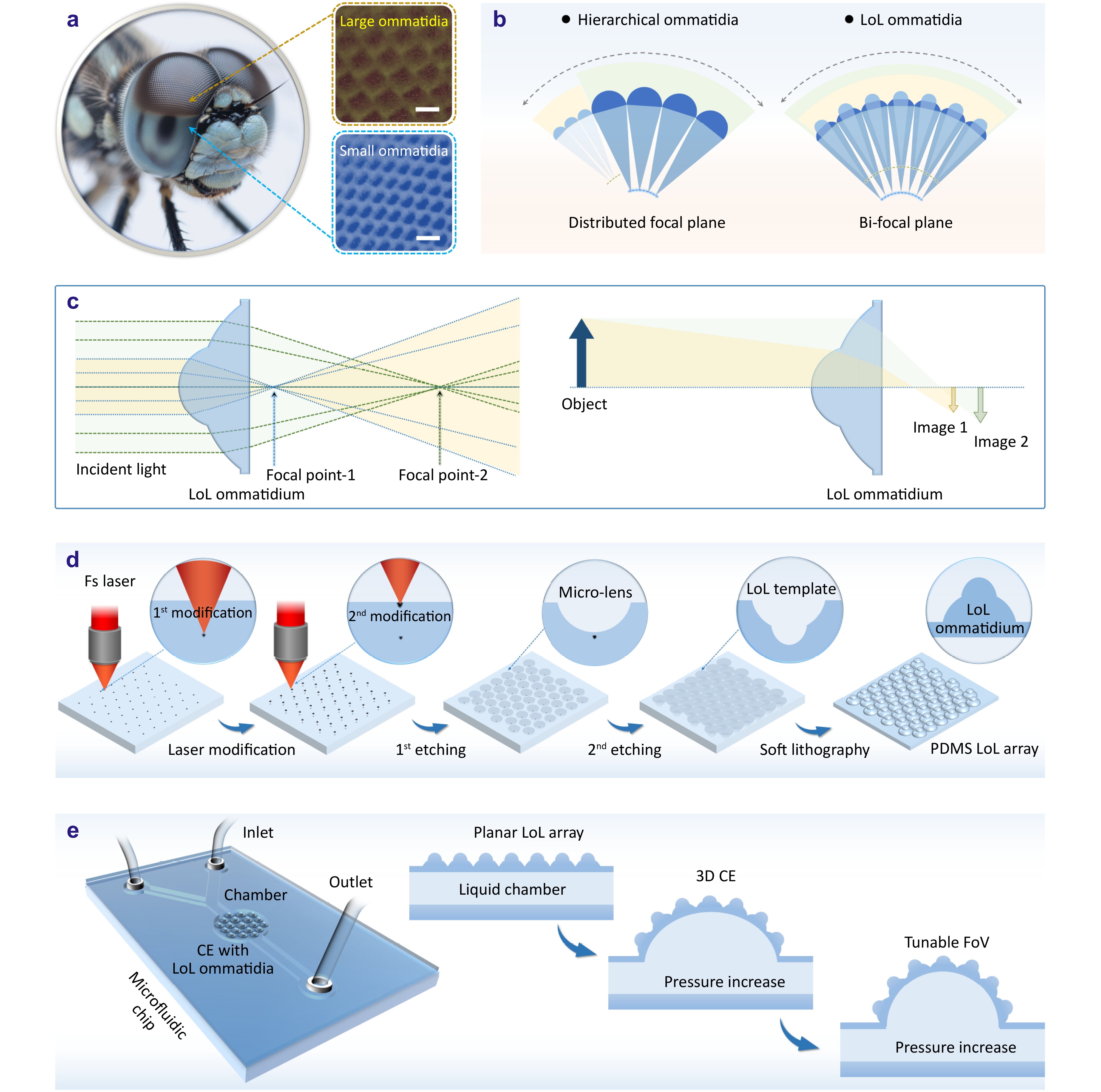
Compound eyes (CEs) offer a unique design paradigm for developing artificial micro-optical systems. However, current bionic CEs still fall significantly short of their insect counterparts in performance, particularly regarding ommatidial spatial arrangement, size distribution, visual field adaptability and environmental perception. Inspired by the CEs of Sympetrum frequens, we developed a tunable bionic CE with bi-focal ommatidia by integrating a flexible lens-on-lens (LoL) array with microfluidics, enabling simultaneous bi-focal imaging.
The polydimethylsiloxane (PDMS) LoL array was fabricated through sequential processing steps, including femtosecond laser dual-modification of quartz glass, two-step wet etching, and soft lithography using the resulting glass template. Integration of this flexible LoL array with a microfluidic chip produced a tunable CE with bi-focal ommatidia, allowing liquid-pressure modulation of CE configurations.
We systematically investigated the optical performance of both LoL ommatidia and the integrated CE, including bi-focal focusing/imaging properties, tunable field-of-view (FOV), large-FOV imaging, and moving target monitoring. This tunable CE with LoL ommatidia demonstrates significant potential for cutting-edge applications.