Mutual empowerment of artificial intelligence and metasurfaces: intelligent nanophotonics and optical intelligence
人工智能与超表面的相互赋能:智能纳米光子学与光学智能
人工知能とメタ表面の相互強化:インテリジェントナノフォトニクスと光学知能
인공지능과 메타표면의 상호 강화: 지능형 나노포토닉스와 광학 지능
Empoderamiento mutuo de la inteligencia artificial y las metasuperficies: nanofotónica inteligente e inteligencia óptica
Renforcement mutuel de l'intelligence artificielle et des métasurfaces : nanophotonique intelligente et intelligence optique
Взаимное усиление искусственного интеллекта и метаповерхностей: интеллектуальная нанофотоника и оптический интеллект
¹ Electronic Information School, Wuhan University, Wuhan 430072, China
中国 武汉 武汉大学电子信息学院
² Peng Cheng Laboratory, Shenzhen 518055, China
中国 深圳 鹏城实验室
³ Wuhan Institute of Quantum Technology, Wuhan 430206, China
中国 武汉 武汉量子技术研究院
⁴ Chinese Academy of Engineering, Beijing 100088, China
中国 北京 中国工程院
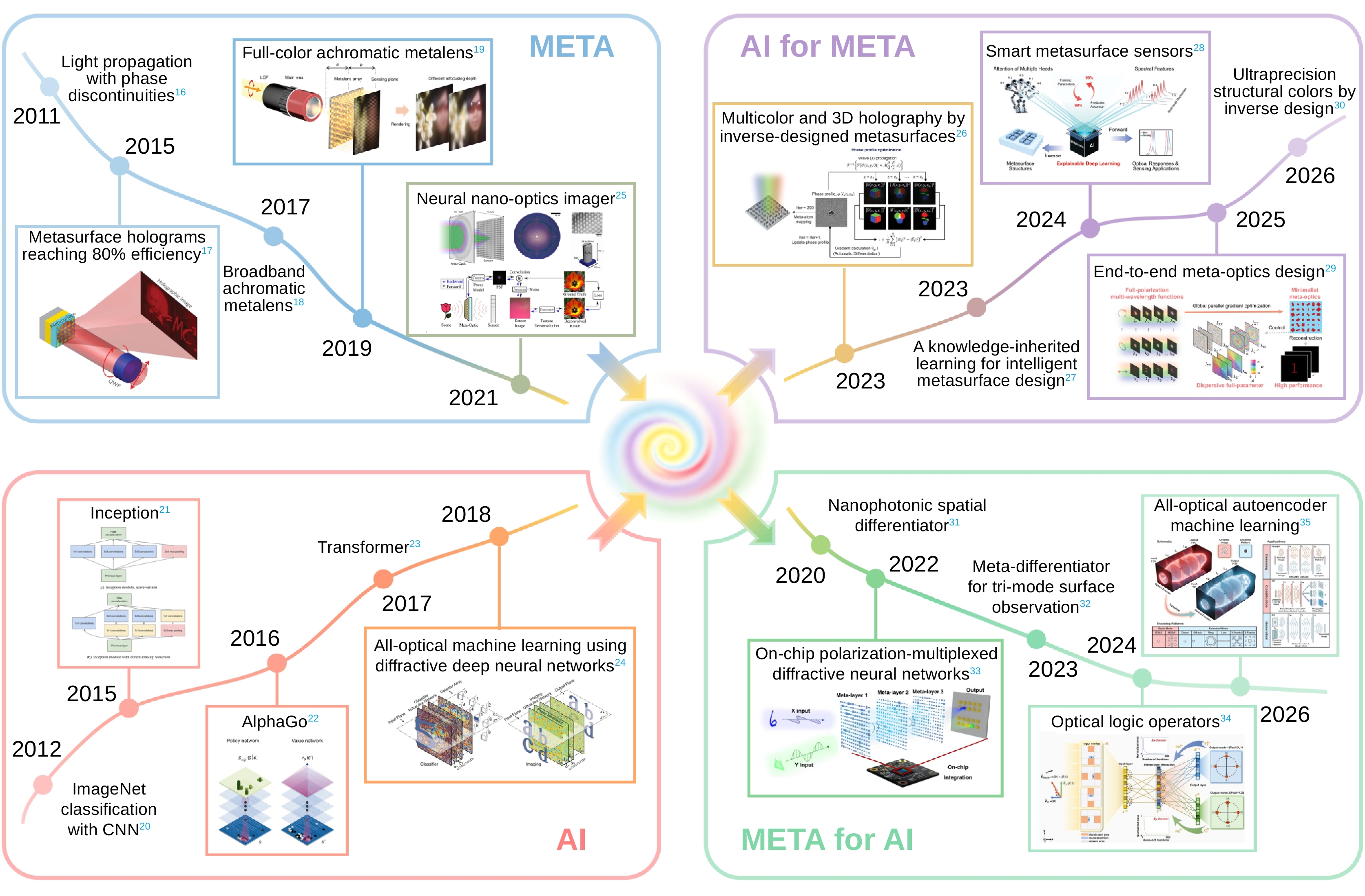
The burgeoning synergy between metasurfaces and artificial intelligence has emerged as a compelling research frontier, characterized by a mutually reinforcing paradigm: artificial intelligence enables intelligent nanophotonics, while metasurfaces facilitate optical intelligence. Leveraging its directional computation and extensive generalization capabilities, artificial intelligence serves as a powerful electromagnetic simulator and modeling engine, accelerating the development of self-adaptive meta-devices.
Conversely, metasurface acts as a versatile electromagnetic wave manipulator and calculating platform, offering inherent advantages in ultrafast processing, massive parallelism, and compact integration, thereby driving the evolution of intelligent computing from electronic to photonic domains. This review systematically surveys parallel advances along these two directions. For intelligent nanophotonics, we examine intelligence-driven methodologies, including physical modeling and structural optimization.
For optical intelligence, we discuss metasurface-enabled frameworks, covering optical mathematical computing and optical neural networks. Finally, we outline future roadmap, emphasizing practical deployment scenarios such as chip-scale intelligent visual perception and communication engineering, aiming to further foster this interdisciplinary filed to the next level.