Programmable directional photonic spiking neuron based on a non-Hermitian silicon microresonator
基于非厄米硅微谐振器的可编程定向光子脉冲神经元
非エルミートシリコンマイクロレゾネータに基づくプログラマブル方向性光子スパイキングニューロン
비-헤르미티안 실리콘 마이크로 공진기를 기반으로 한 프로그래밍 가능한 방향성 광자 스파이킹 뉴런
Neurona espinosa fotónica direccional programable basada en un microresonador de silicio no hermitiano
Neurone photonique à impulsions directionnel programmable basé sur un micro-résonateur en silicium non hermitien
Программируемый направленный фотонный импульсный нейрон на основе неэрмитова кремниевого микрорезонатора
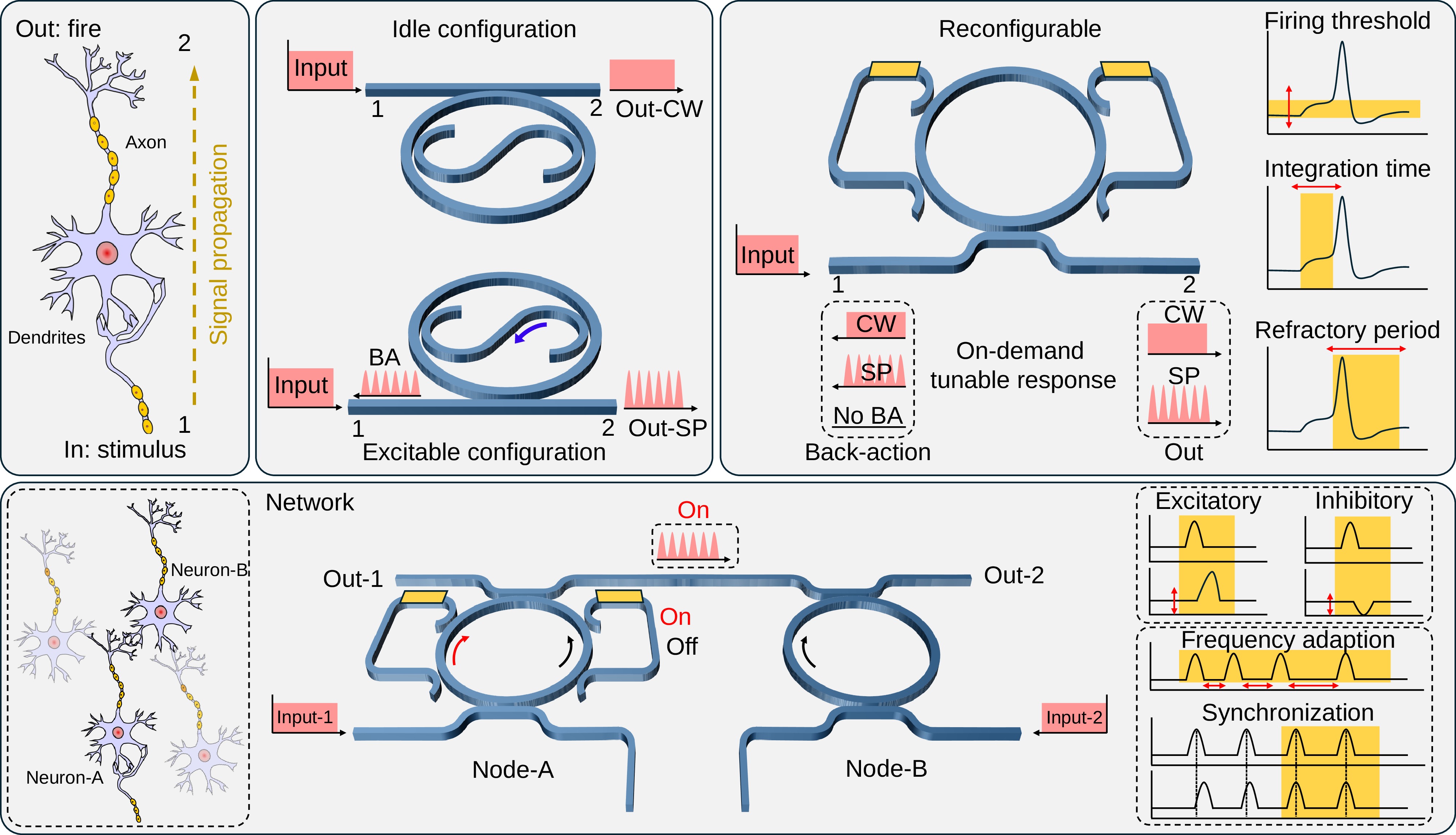
Traditional computing architectures are increasingly constrained by the “Von Neumann bottleneck”, motivating energy-efficient, brain-inspired neuromorphic systems. Silicon photonic microresonators can emulate key neuronal dynamics such as spiking and excitability. However, in reciprocal microresonators, forward spike emission and backward signals are intrinsically linked, limiting independent control of directionality, feedback and inter-node back-action.
Here, we overcome this limitation by exploiting engineered intermodal coupling in non-Hermitian photonic resonators to realize directional excitability in all-optical neurons. First, we show that Taiji microresonators exhibit direction-dependent self-pulsing thresholds, enabling a single device to act as a spiking neuron in one direction while remaining quiescent in the opposite. Then, we introduce the dynamically reconfigurable unified microresonator (DRUM), which enables electrical control of intermodal coupling amplitude and phase. This allows independent control of forward spike emission and backward signals, suppression or enhancement of back-propagation, and active tuning of neuronal properties. We experimentally demonstrate directional spiking asymmetry alongside tunability of temporal integration and refractory period, establishing DRUM as a programmable photonic spiking neuron.
Finally, network-level simulations show that controlled back-action can mediate synaptic-like behavior, including inhibition and synchronization. These results identify reconfigurable non-Hermitian silicon microresonators as promising building blocks for photonic spiking nodes with programmable directionality, back-action, and temporal response.